American Horror Story’s Main Titles Designer Breaks Down the Iconic Opening Credits, From Murder House to AHS: 13
Exclusive: Title sequence designer Kyle Cooper (Se7en, Mission: Impossible) unpacks his 13 haunting preludes for the TV phenomenon
by Lana Thorn & Alex Kaan Updated 30 October 2026 | Originally published in Issue 001
FX / Prologue
Kyle Cooper is the biggest name in title sequence design today. After co-founding design studio Imaginary Forces (Stranger Things, Mad Men), he became the lead creative director of Prologue Films and has worked across major superhero franchises (Spider-Man, X-Men: First Class, Iron Man), the Mission: Impossible (1 and 4) series, and the prolific television oeuvre of Ryan Murphy. For horror and genre fans, he’s best known for the terrifying serial-killer POV sequence that opens Se7en: a game-changer that redefined how main titles could complement a film.
With Prologue, Cooper has produced and directed hundreds of main title and visual effects sequences across a wide spectrum of film and broadcast mediums. Details magazine holds the multi-award-winning designer responsible for “almost single-handedly revitalising the main title sequence,” while Wired asserts that “not since Saul Bass’ legendary preludes […] have credits attracted such attention.”
With an education from the best in American graphic design — Paul Rand and Alvin Eisenman — Cooper attributes the resonance of his work to time-tested artistic principles. “When you’re measuring art, the same kind of criteria can be used all throughout history,” he tells Phantasmag from his home in California. “The best work comes when you aren’t just doing something trendy, but thinking about form and classic design theories.”
While Prologue’s titles preface a range of Hollywood tentpoles, Cooper has a special relationship with the horror genre. He was born on Friday the 13th, after all, and definitively broke into the industry with the eerie, jittery sequence for Se7en, where he hand-scratched the titles onto the film stock. It showcased an ability to single out a script’s subconscious, shooting new material that foregrounded the film’s symbolism and set the tone. “I look for beauty in some really dark things,” Cooper says of his process.
Nowhere is this ability more clearly on display than in his work on American Horror Story. Since premiering in 2011, Ryan Murphy and Brad Falchuk’s hit anthology series has been revolutionary both for bringing full-blown horror to network television (its graphic violence and sex surpass any previous spooky TV series) and for its pioneering representation of women and queer characters. Each of its 13 seasons is a mostly self-contained horror miniseries, defined by a recurring troupe of actors, the veteran members of which (Jessica Lange, Sarah Paulson, Evan Peters, and more) have now returned for its new instalment, the all-star crossover event AHS: 13.
Cooper’s title sequences for the series have built up a following in their own right. With each season, fans eagerly await his collage of disparate, creepy imagery and try to dissect what it means for the story. Catching up with Phantasmag, the director/designer reflects on the origins of Coven’s famous winged demon, how Se7en and Final Destination helped him get the AHS job, and paying tribute to his previous work on his new title sequence for AHS: 13.
Murder House
FX / Prologue Films
The first season of American Horror Story, retroactively titled Murder House, was instantly a force to be reckoned with. Telling the story of the Harmon family as they move into the titular haunted home, the show had all it needed to be a classic: a BDSM killer called the Rubber Man; the twisted love story of Tate and Violet (Romeo and Juliet, but worse); and dialogue that will forever be quoted on the Tumblrs and TikToks of the future: “Who is junglejim4322?”; “There’s not going to be a swimming pool, you stupid slut!”
Dark forces were at play when Cooper first designed the iconic titles for AHS. Cooper had a meeting with Ryan Murphy, who was understandably curious about collaborating with the man who did Se7en. “He asked me if I had done the title sequence, and I said yes. He was like, ‘Did you really do it?’ and I said, Yeah!”
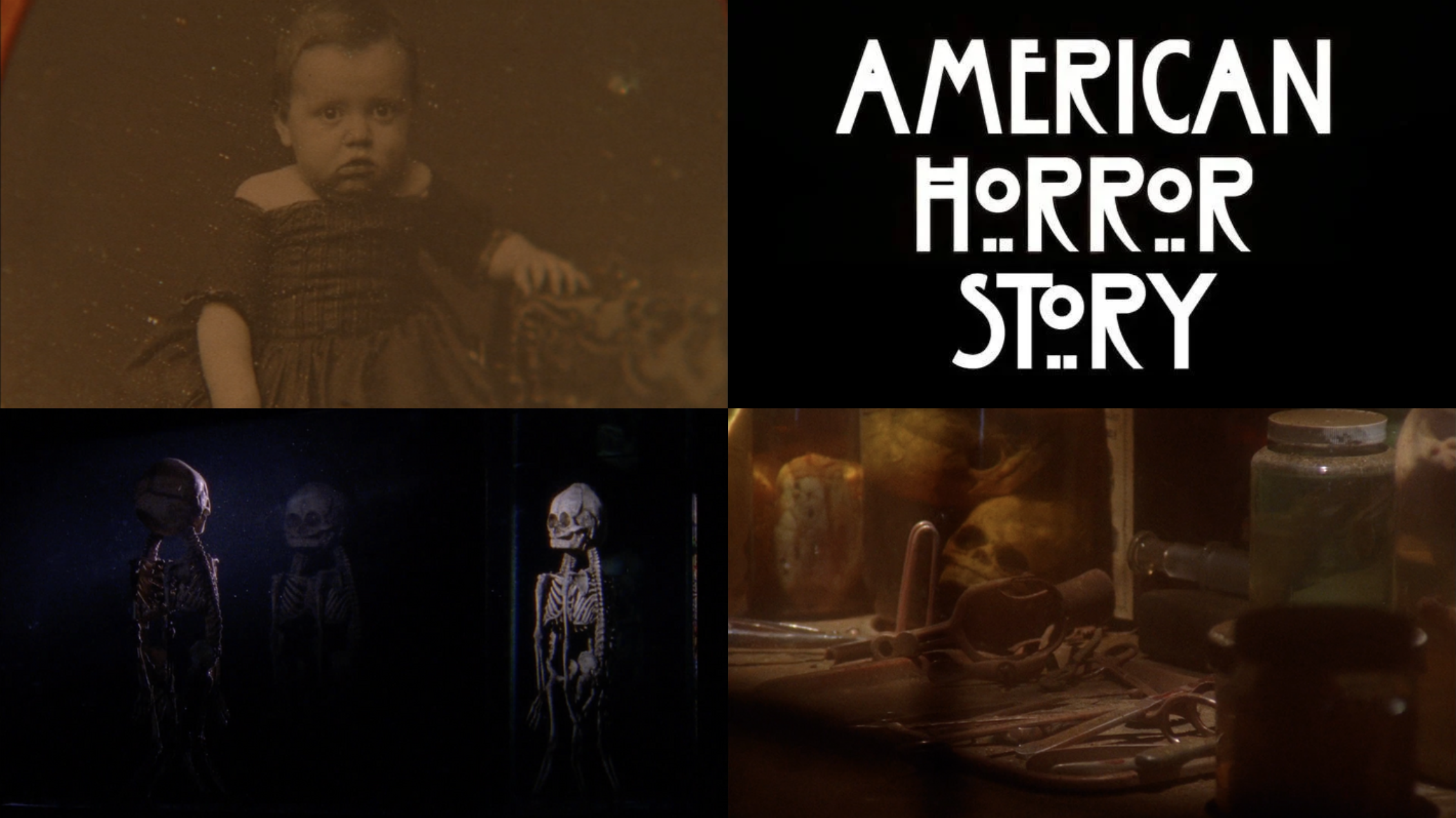
Before long, Cooper paid a visit to the murder house. He sat in Murphy’s car near the set, listening to temp music the co-creator had selected for inspiration. As he considered the various elements of the brief, Cooper had an idea. He had read the scripts about the Harmon family and their home’s carnival of lost souls, but was particularly struck by the tragic story of Thaddeus Montgomery: the child who was dismembered and grotesquely reassembled to create a Franken-baby known as the Infantata.
“I took a risk by shooting stuff myself before I was even awarded the job,” Cooper explains. He was filming the sequence for Final Destination 5 in an old Mary Pickford Studios stage, which came with a creepy basement. The Infantata lives in the basement of the murder house, so Cooper, on the fly, decided to use the set and shoot a proof-of-concept of the title sequence from the creature’s POV. “I ran around with a 16mm camera at my thigh level, like I was this little creature lurking downstairs,” he explains. The unsettling movement is intercut with the bloody tools of the evil Dr Montgomery, the Infantata’s christening dress falling in slow motion, and the piercing stares of children in sepia-toned pictures (Cooper was fascinated by the thought of the babies idly watching all the violence). With all its spontaneity, that first experience, to this day, is one of his fondest memories of working on the series.
The title sequence wouldn’t be complete without its famed music: a glitchy piece that mostly ditches melody in favour of churning, gurgling sound design that gets under the skin. Cooper’s editor, Gabriel Diaz, had a friend who was a composer. They presented an edit to Murphy, set to César Dávila-Irizarry’s unique track (which would ultimately be reworked by Saw composer Charlie Clouser). “Usually they give you a score, or you shoot something, and then they score to it. But we proposed that music, and Ryan liked it.” The series’ signature font was also born out of a back-and-forth with Murphy. “He showed me a book about Frank Lloyd Wright, which had a sort of Art Nouveau font. I saw it and thought of the Charles Rennie Mackintosh font.” Cooper speaks highly of Ryan Murphy and producer Alexis Martin Woodall: “They’re very collaborative. With the titles, we established the brand together.”
Asylum
FX / Prologue Films
AHS returned in 2012, swapping the haunted house for a 1960s psychiatric hospital. The season is even darker than its predecessor, relying less on tongue-in-cheek humour and instead spotlighting the real-life injustices that would occur in such a facility at the time. It features Murphy’s long-time muse Sarah Paulson in her first leading role as the stubborn journalist, Lana Winters, imprisoned in the asylum for her lesbian sexuality.
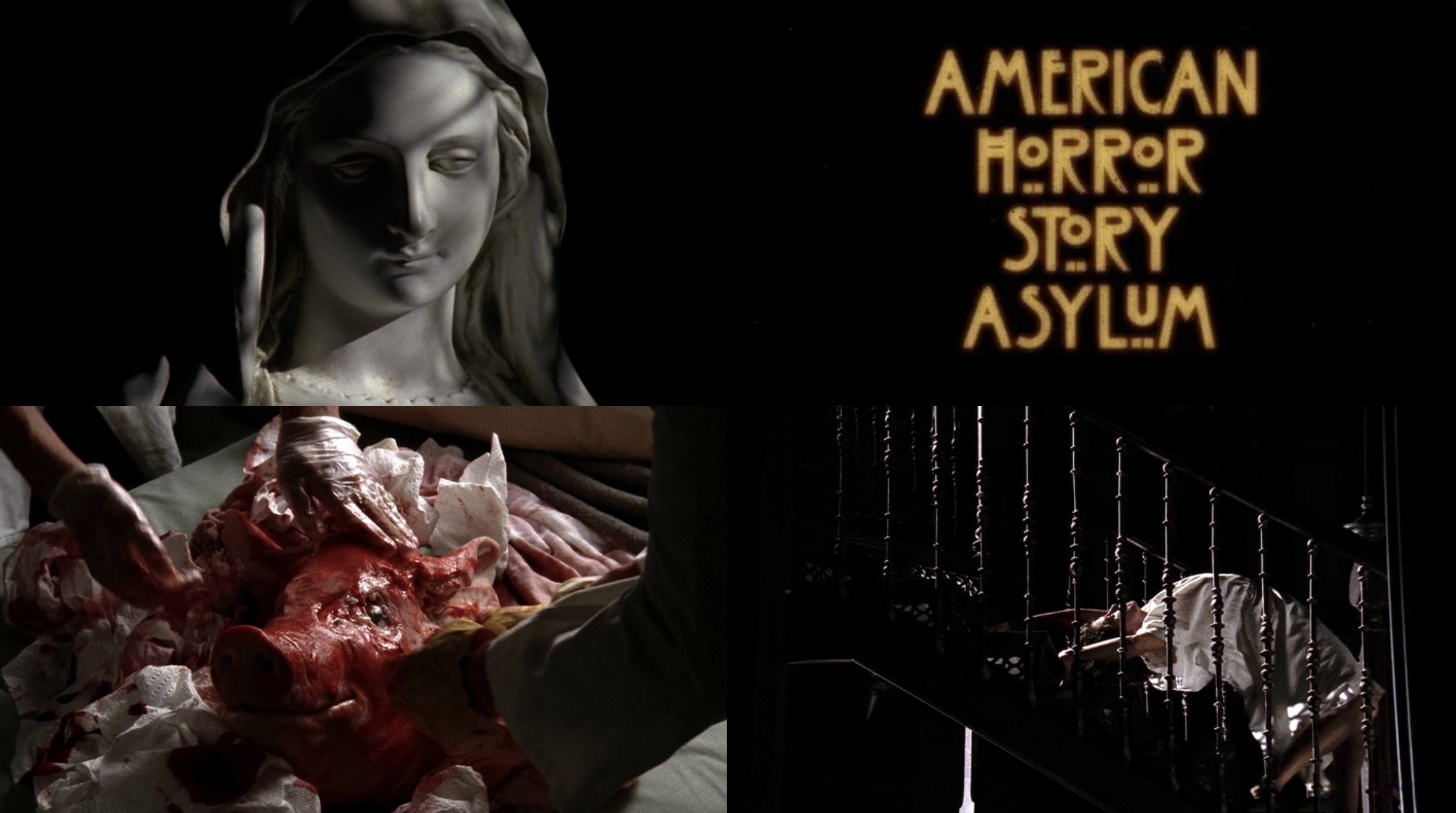
Asylum is unique in that Cooper shot the sequence on the show’s actual set. His 16mm camera guides us through the institution, amidst flashes of troubled patients, devious doctors, and horny nuns.
“I didn’t think of it as a sequel. I don’t think of any of them as sequels, but they’re part of the same family,” he says. While the music, font, and editing styles are consistent across many seasons, each one of his sequences scares in its own way.
Cooper even makes an appearance himself. “We had a woman who was supposed to be thrashing on the bed, but I couldn’t get her to do it. She was an extra, not an actress. So I put on the apron and started wringing my hands and rocking back and forth.” He admits the transition to acting wasn’t too trying. “There’s a lot of anxiety shooting in these situations, so I think I was already feeling like that anyway.”
Coven
FX / Prologue Films
In 2013 on Tumblr, the third season of AHS reigned supreme. With its almost all-female main cast, heightened humour (one word: Balenciaga!), and the season-long mystery about who would become the witches’ leader, Coven took the series to new heights and grew its already impressive legion of die-hard fans. Having Kathy Bates, Angela Bassett, and Stevie Nicks join the party certainly helped.
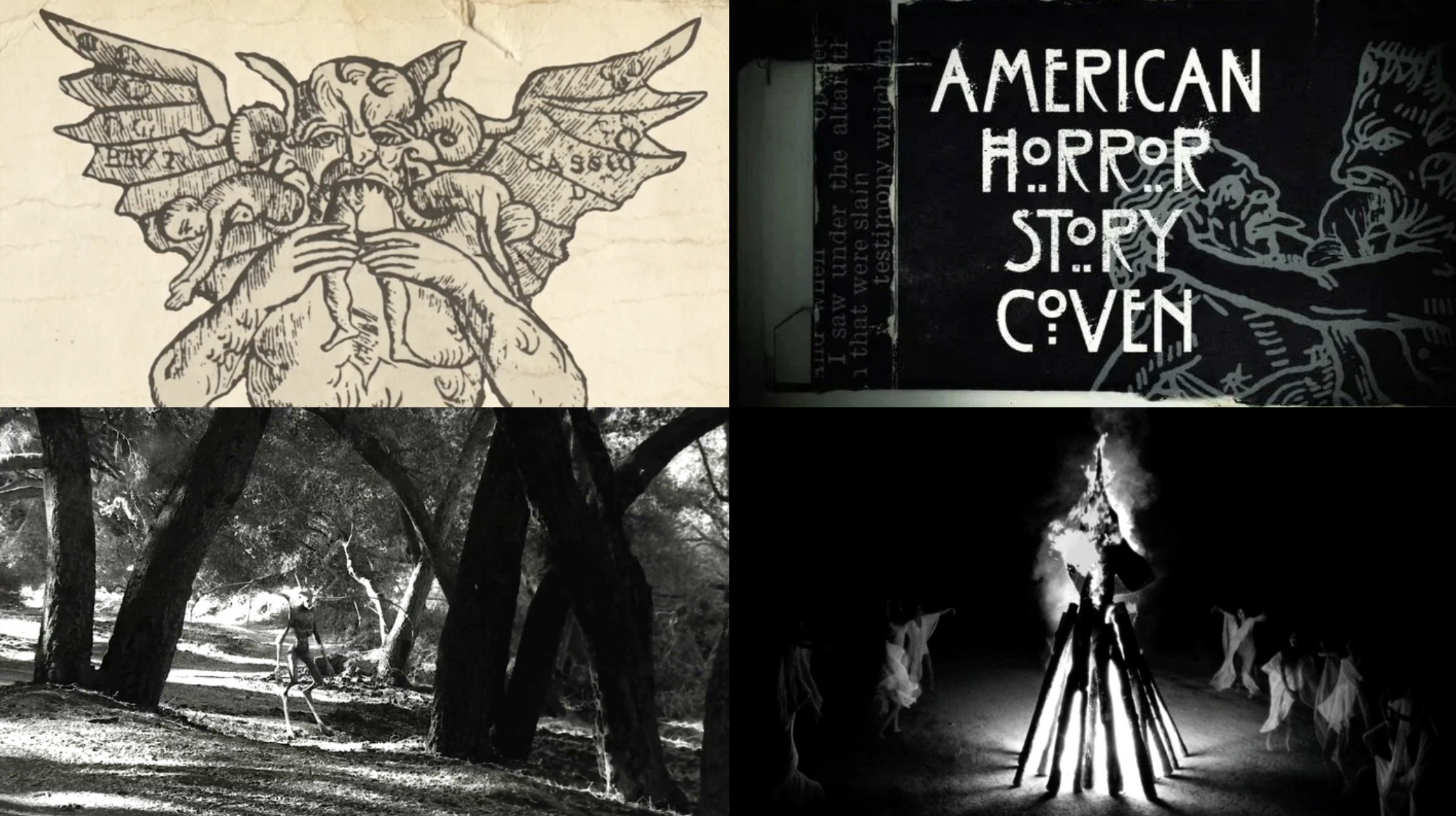
Cooper responded to the material with raging pyres, menacing cloaked figures, and goats both real and sketched. It’s the first season to feature discernible animation, where each actor’s title card is accompanied by a moving drawing—a black cat for Kathy Bates, a row of hanged men for Denis O’Hare.
One frame in particular captured fans’ attention: a skeletal, winged demon standing alone in the woods. “No, I didn’t know that [the creature went viral on Tumblr]. It was originally made for something else, a pitch for a film adaptation of CS Lewis’ The Screwtape Letters. That fell through, but I had this model, and I wanted to use it.”
In designing the demon, Cooper enlisted skills he’s had since childhood. “I liked horror movies. Not slashers, but monster movies. I would obsessively sharpen my pencil and draw these incredibly detailed creatures. It was a way to lose myself and process difficulties in my life.” For Coven, he drew inspiration from goat heads and bat wings and hired a 3D specialist to make the model we ultimately see in the titles. “I put it in the sequence, and nobody complained. I thought it would be spooky and make the audience go, What’s that?”
Freak Show
FX / Prologue Films
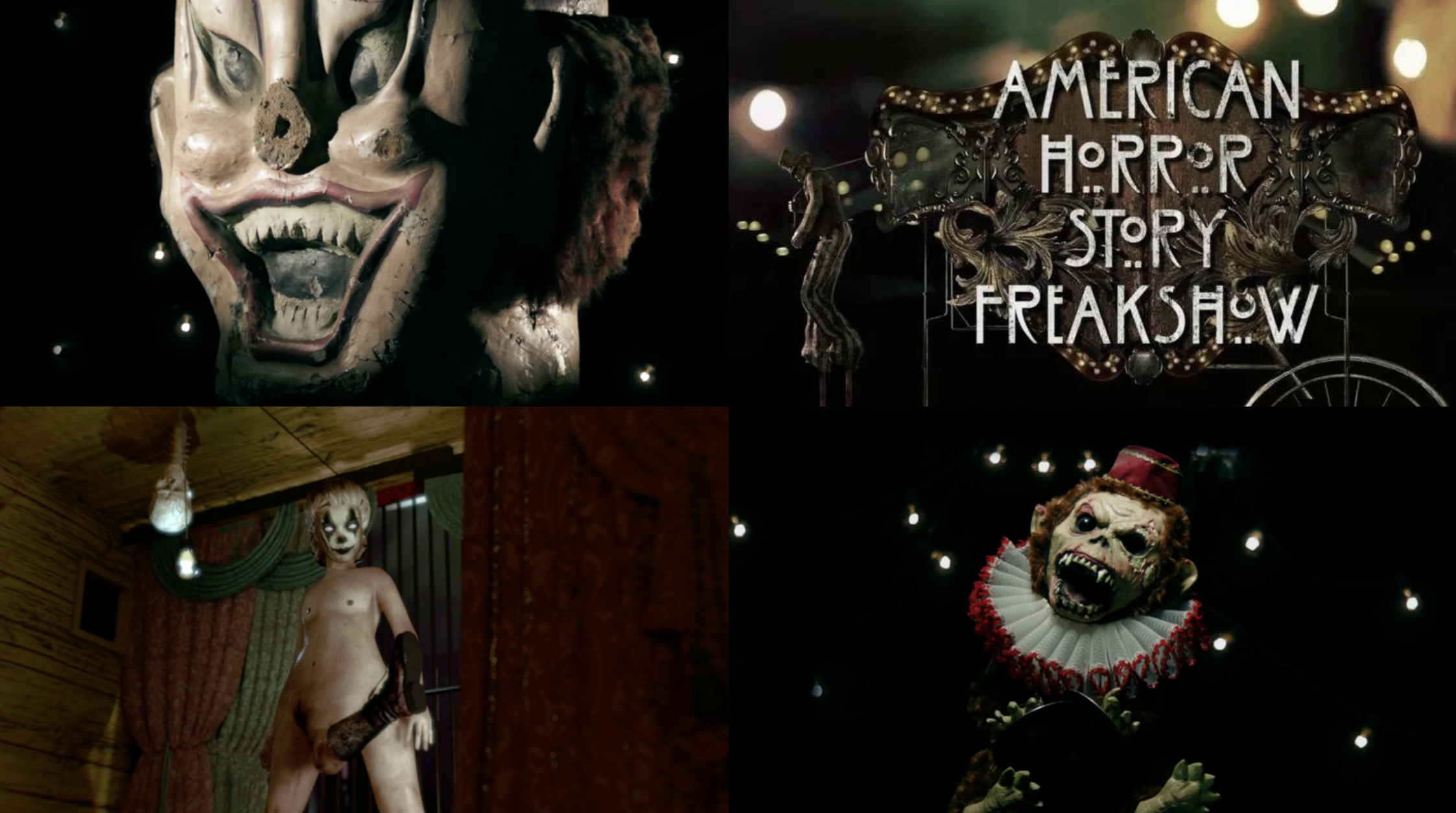
With Jessica Lange’s last season in the main cast until this year’s thirteenth instalment, AHS went to the circus. It’s as crazy as you would hope. There’s a maniacal clown killer, a two-headed Sarah Paulson, Lange singing Bowie and Lana Del Rey, and Evan Peters using his large cleft hands to offer unique sexual services.
While Cooper’s first three sequences all splice various disturbing visuals shot on 16mm, Freak Show breaks the mould and leans into stop-motion. By playing the main theme on a music box, it also adjusts Dávila-Irizarry’s and Clouser’s music for the first time—which now sounds like the arrival of an ice cream truck from hell. Led by the hypnotic score, the sequence invites us to meet the “freaks.”
“We built a miniature circus set,” Cooper explains. “We were thinking about stop-motion animators like Wladislaw Starewicz, the Quay Brothers, and Ray Harryhausen. We built it shot by shot, drawing and modelling circus wagons and baby sculptures that pulled their own heads off.” The creatures - ranging from lustful little skeletons grinding on each other to a machine man hammering nails into his head - are realised through a mix of stop-motion, CGI, and live-action to a highly uncanny effect. With its pronounced body horror, it’s one of the most disturbing sequences.
Hotel
FX / Prologue Films
Two words: Lady Gaga. In her first lead acting role (for which she would win a Golden Globe), Gaga plays the Countess: a fashionable hundred-year-old vampire and owner of the thoroughly haunted Hotel Cortez. Its residents include Sarah Paulson as an addict with severe abandonment issues, and Evan Peters as a comedic killer inspired by real-life monster H. H. Holmes. There’s gore aplenty, but the camp is heightened. At one point, vampire Matt Bomer does the Drake dance to Hotline Bling.
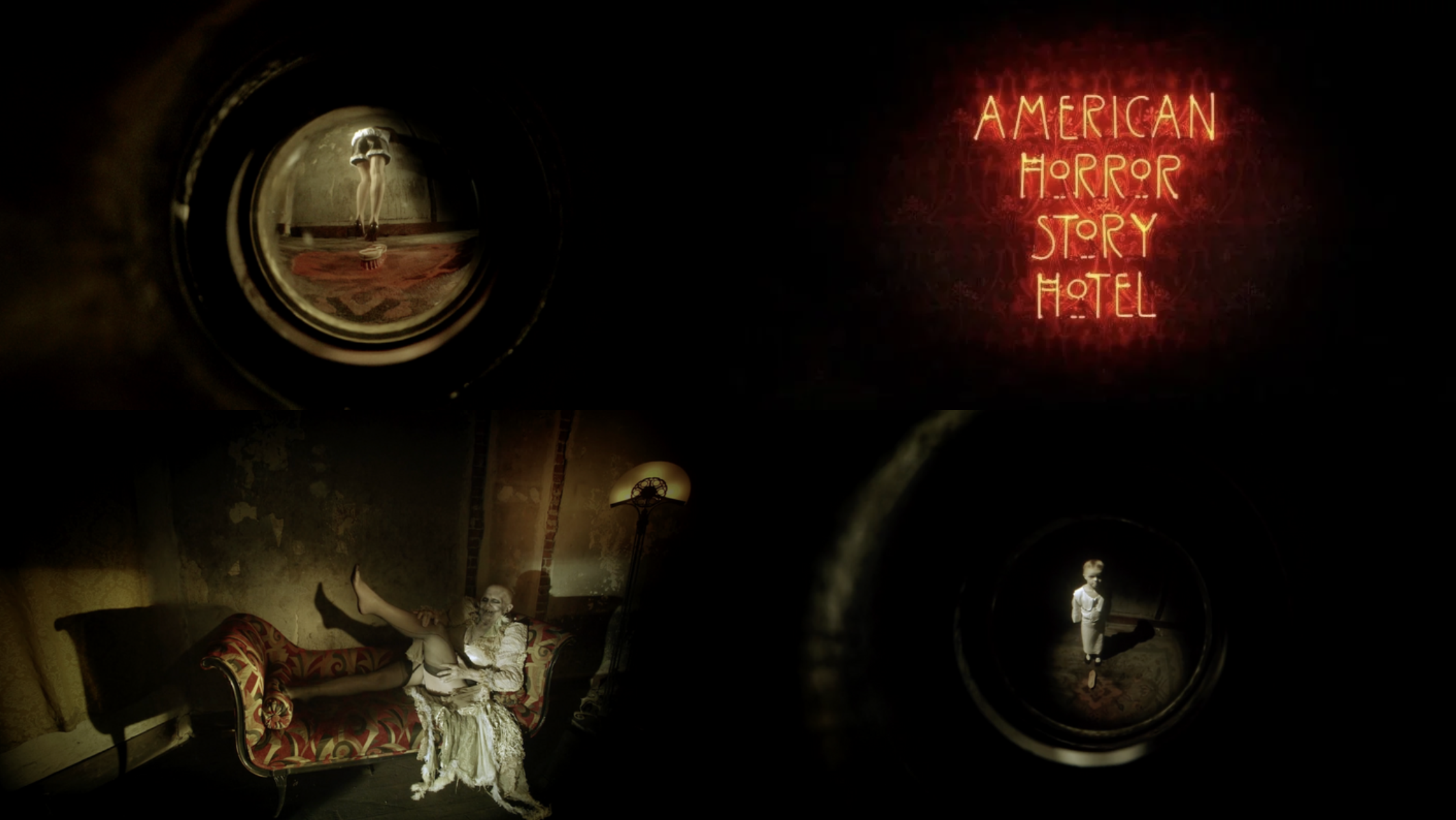
Watching Cooper’s seedy, voyeuristic title sequence is the perfect way for fans to check in to the Hotel Cortez. Set to another remix of the theme (this time a synthetic violin plays the main melody, evoking an old record the Countess may have enjoyed before she turned), the intro is a highlight reel to make you rethink your next weekend getaway. Maids scrub pools of blood, creepy kids roam the hallways, and monsters crawl out of mattresses.
To play on fears of disturbed privacy, Cooper had a nifty camera trick. “I really liked the way that the characters looked through a peephole. So we took a real peephole with glass in it, and mounted it to the lens.” The added framing encourages viewers to sneak a peek. But beware, you might find a witch with a toothy grin suggestively rubbing her stockings.
Cult
FX / Prologue Films
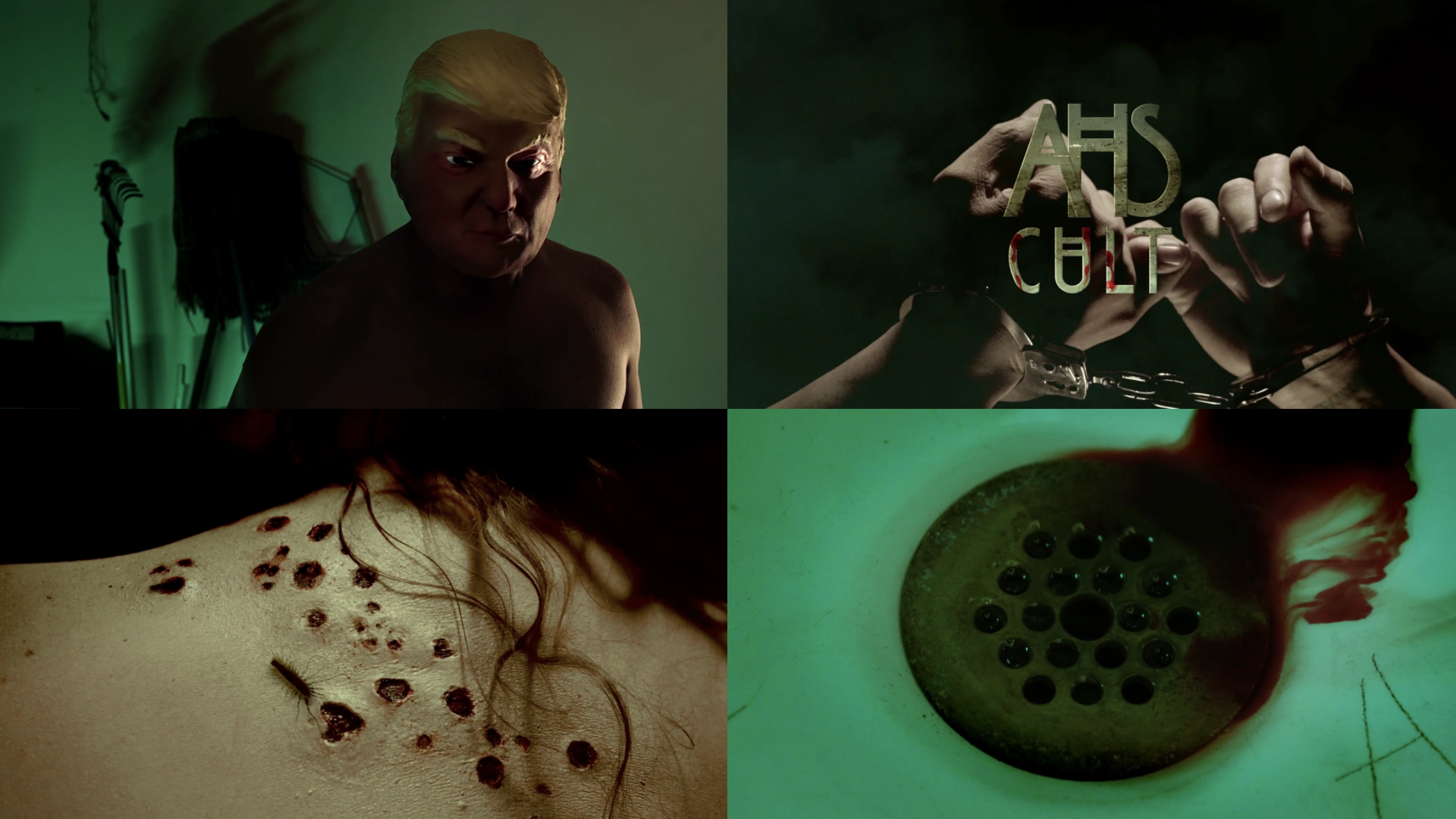
After a year off with Roanoke (in a meta twist, the show’s sixth season was presented as a fictional true-crime programme), Cooper returned with the politically charged Cult. The season, which went into production mere months after the 2016 election, plays out as a battle between the show’s longtime male and female leads. With one radicalised and the other traumatised by Trump’s win, it’s Evan Peters’ charismatic cult leader (Kai) vs Sarah Paulson’s phobia-ridden lesbian (Ally)—who worries the president’s policies will tear her family apart.
“I wasn’t really trying to make any reference to current events,” Cooper admits. While the sequence does tip its hat to America’s political chaos (there are cameos for both Trump and Hilary masks, and the theme music is now played on mockingly patriotic military horns), the director/designer prioritises Ally’s phobias. “I was thinking more about her fears, like the bees. I also focused on the dead dog and those gas masks that people had to wear.” Ally has trypophobia (the fear of clusters of holes), and Cooper accordingly fills the sequence with beehives and bloody drains. She’s equally spooked by clowns, so he puts some on a merry-go-round in Los Angeles’ Griffith Park. With Ally’s phobias as a manifestation of a queer woman’s distress in the time of Trump, the titles elegantly explore the frightening realities of the election.
Apocalypse
FX / Prologue Films
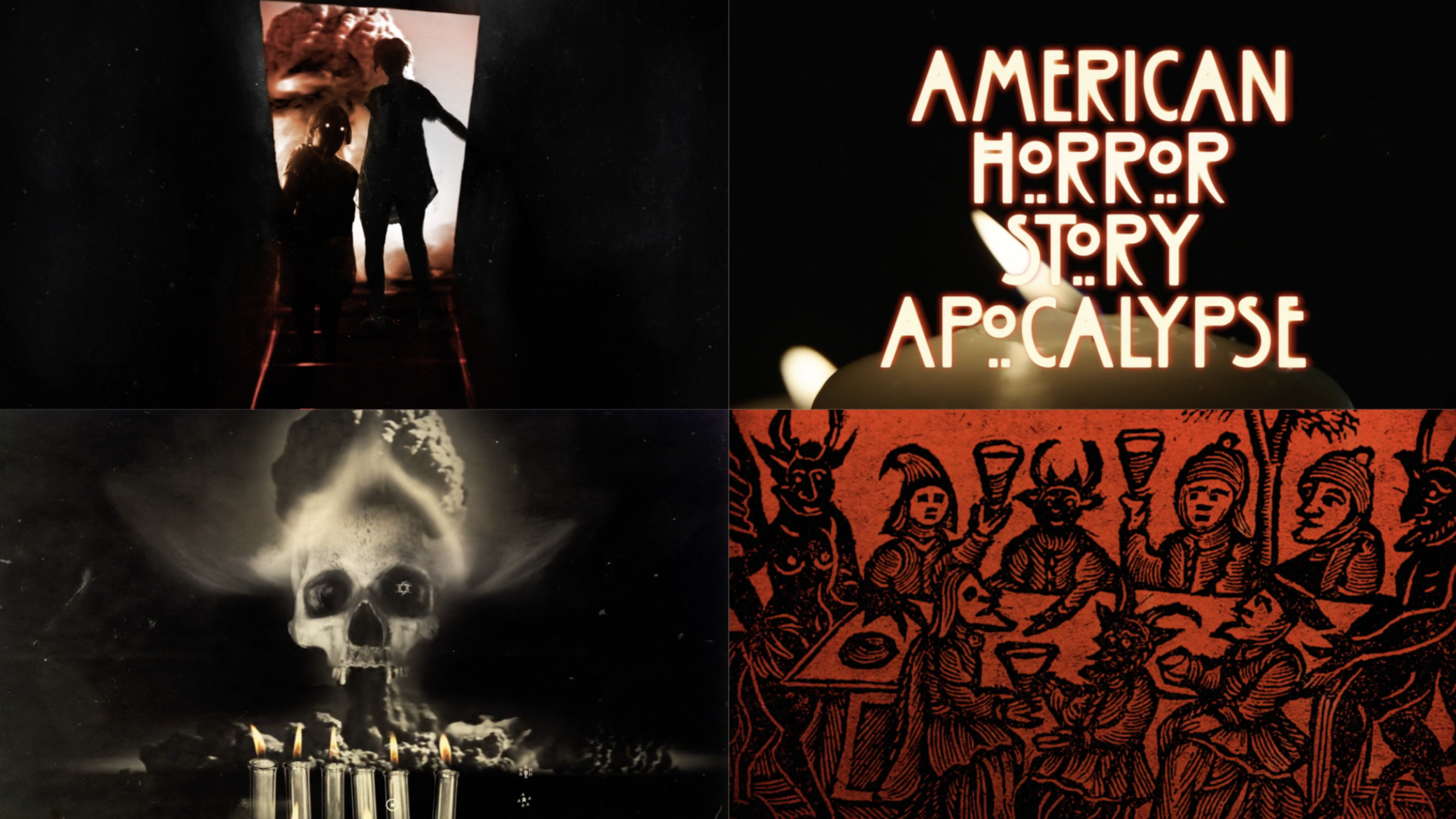
The only legitimate “sequel” in the franchise until the thirteenth season, AHS’ eighth instalment deceptively begins in a nuclear fallout shelter before revealing itself as a crossover between Murder House and Coven. The witches from the latter season fight to take down the Antichrist introduced in the former.
“It had to be devils and goats and satanic stuff, but also explosions,” Cooper says. “We needed to reference the previous seasons as well as the iconography of the mushroom cloud.” Time-lapses of melting candles (the necessary light source in the end-times) intertwine with shots from sequences 1 and 3. In a testament to the power of Cooper’s work, these images are instantly recognisable to any fan: the glassy-eyed children from Murder House, the famed skeletal demon of Coven, and the Infantata’s falling christening dress.
1984
FX / Prologue Films
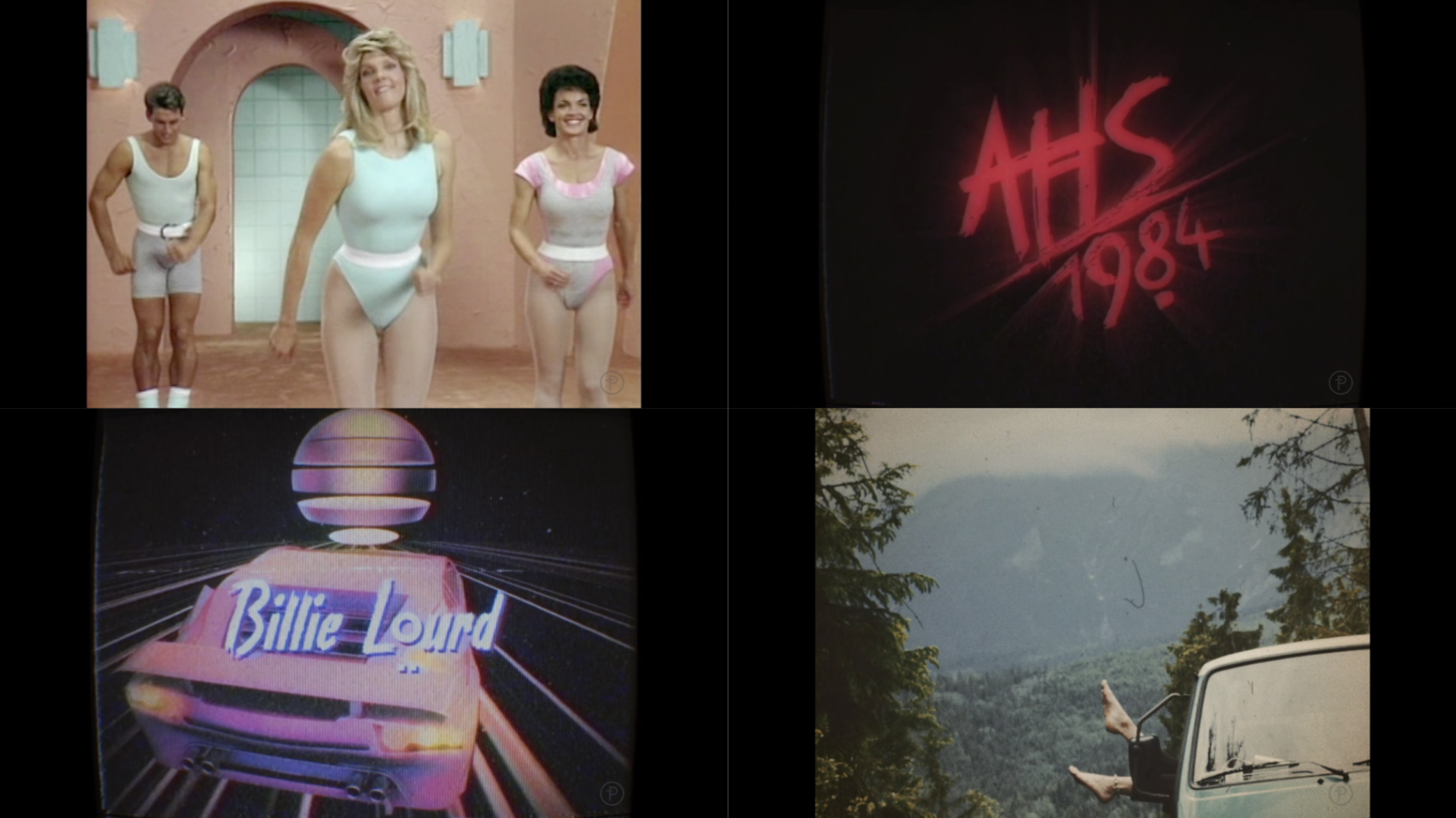
It began with the haunted house tale, updated witch horror for the 2010s, and served up a twisted political thriller. With its ninth season, AHS took on the 80s summer slasher. Franchise mainstays Emma Roberts and Billie Lourd are camp counsellors who dabble in jazzercise, while their Jason/ Michael figure is a killer janitor by the name of Mr Jingles (his noisy keys signal your death).
With 1984, Cooper again breaks the mould with a collage that plays gleefully with the aesthetic of the period. Roller skates, Walkmans, Ronald Reagan, and title cards drenched in neons as bright as the aerobics outfits the sequence also spotlights. The main theme has morphed into a spunky synth slasher score. No 80s touchstone is left unturned.
With a huge, international fanbase, it’s become customary for AHS devotees to make their own title sequences in anticipation of the real thing. When the season’s setting was announced, Corey Vega assembled a fan edit (his idea was a “cursed VHS tape” capturing the look of the perfect 80s slasher) that caught the eye of Ryan Murphy. Soon, he was collaborating with Prologue as a conceptual designer. “Getting to work with Kyle Cooper and his ridiculously talented team was a dream,” Vega tells us. “His work speaks for itself—he’s so great at what he does, and knew exactly what questions to ask to get our final product.”
“Corey’s version was mostly stock footage and scenes from films that felt right for the period,” Cooper explains. “So we were inspired by that, and I talked to him about his reasoning for the imagery he chose.” From there, the designer stitched together his own collage, predominantly of stock clips, while Prologue also shot new material (like the man ominously dragging an axe) covered luxuriously in film grain.
Read Corey Vega’s exclusive first-person account, where he talks about everything from creating his original fan edit to the wonderful shock of hearing from Ryan Murphy’s team.
Double Feature: Red Tide
FX / Prologue Films
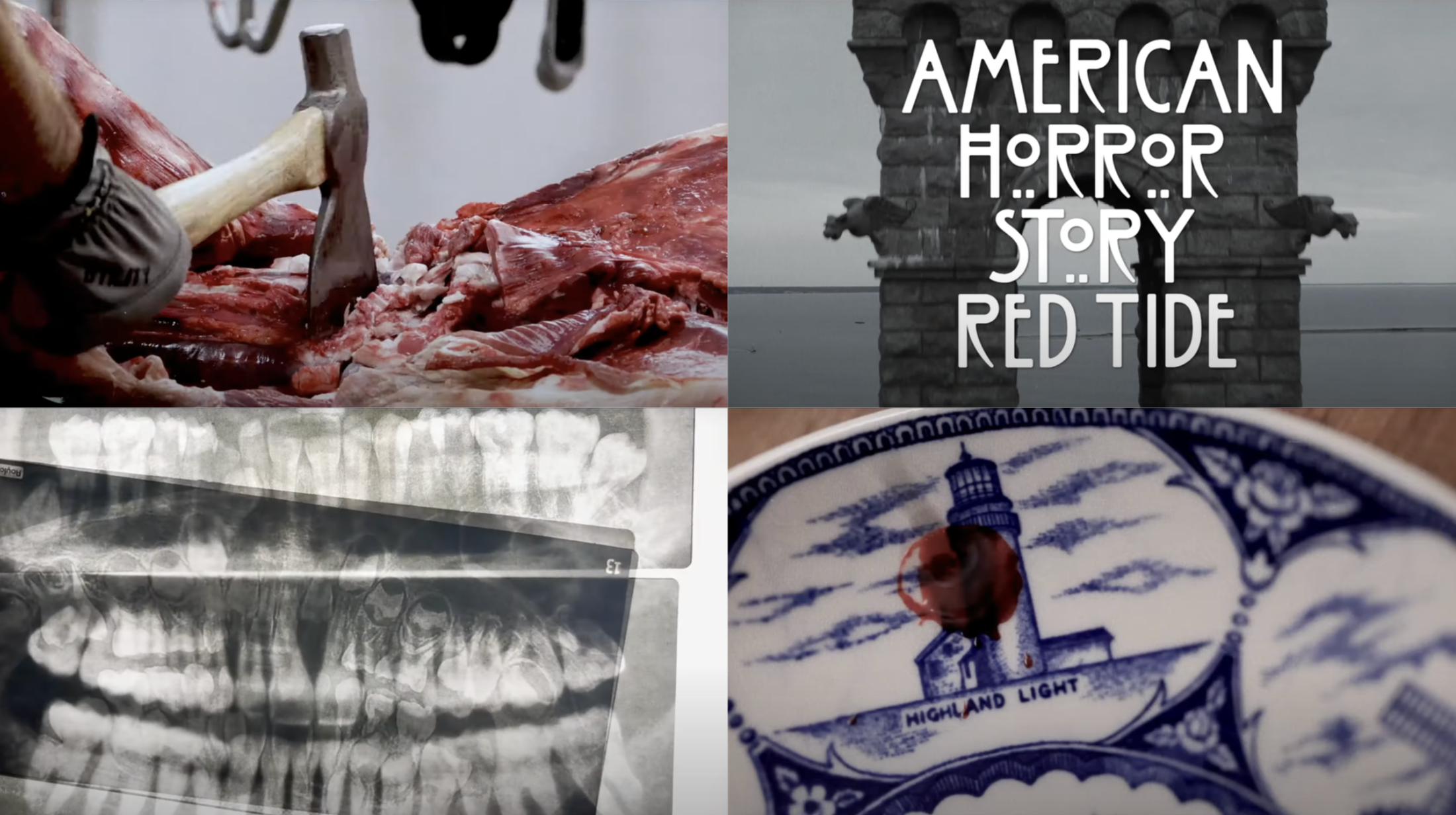
With Red Tide’s story of coastal bloodsuckers, Cooper latched onto the image of meat decorated with dripping blood. “I have a cinematographer, Farhad Akhmetov, and I sent him to the butcher’s. I guess we got carried away.” The sequence has an especially quick rhythm, where cryptic close-ups of typewriters, syringes, and violins (all clues for the story to come) blend together. “Work like that requires more editorial precision. A lot of things I wanted to include were better off captured with stock footage, and so the edit was naturally faster.”
Double Feature: Death Valley
FX / Prologue Films
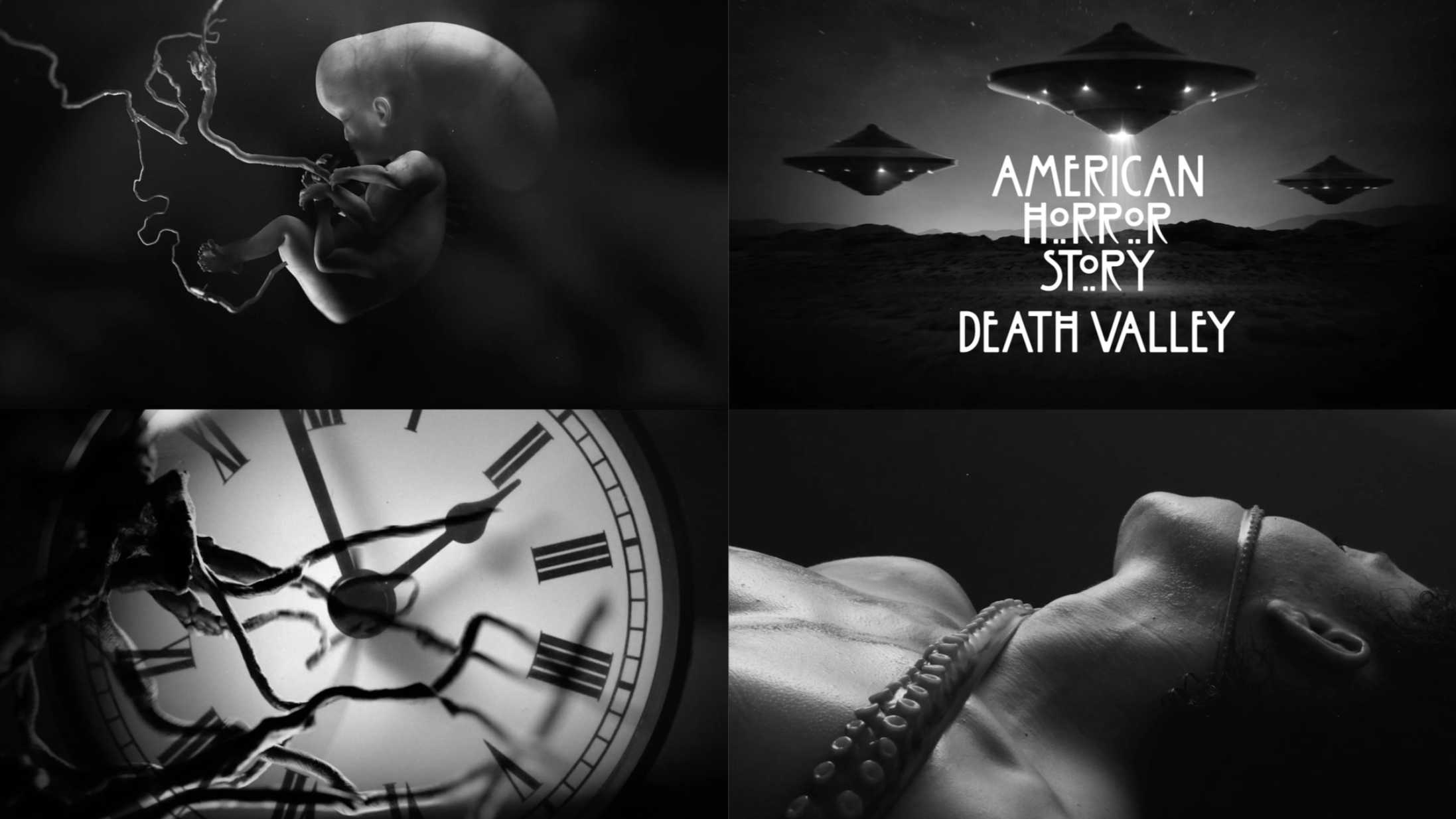
For Death Valley, Cooper returned to body horror. “The script mentioned the aliens having tentacles, so we got a squid. The sequence came from a visual I imagined of the alien squirming around in something like water.” In a mix of CGI and practical effects, the squids’ tentacles undulate against a black background and menacingly wrap around naked bodies. Soon, they become grotesque pseudo-umbilical cords for extraterrestrial babies. If you weren’t scared of alien pregnancy before, thanks to Cooper, you surely are now.
NYC
FX / Prologue Films
With its groundbreaking representation, AHS has long spotlighted the LGBTQ+ community with complex, fully-rendered characters. In its 11th season, the horror is centred entirely on the AIDS crisis in 1981 New York City. The ensemble cast of queer characters is hunted by Big Daddy, an extremely brawny killer dressed in BDSM wear, who is as sexy as he is deadly. We’ll leave it to you to work out the metaphor.
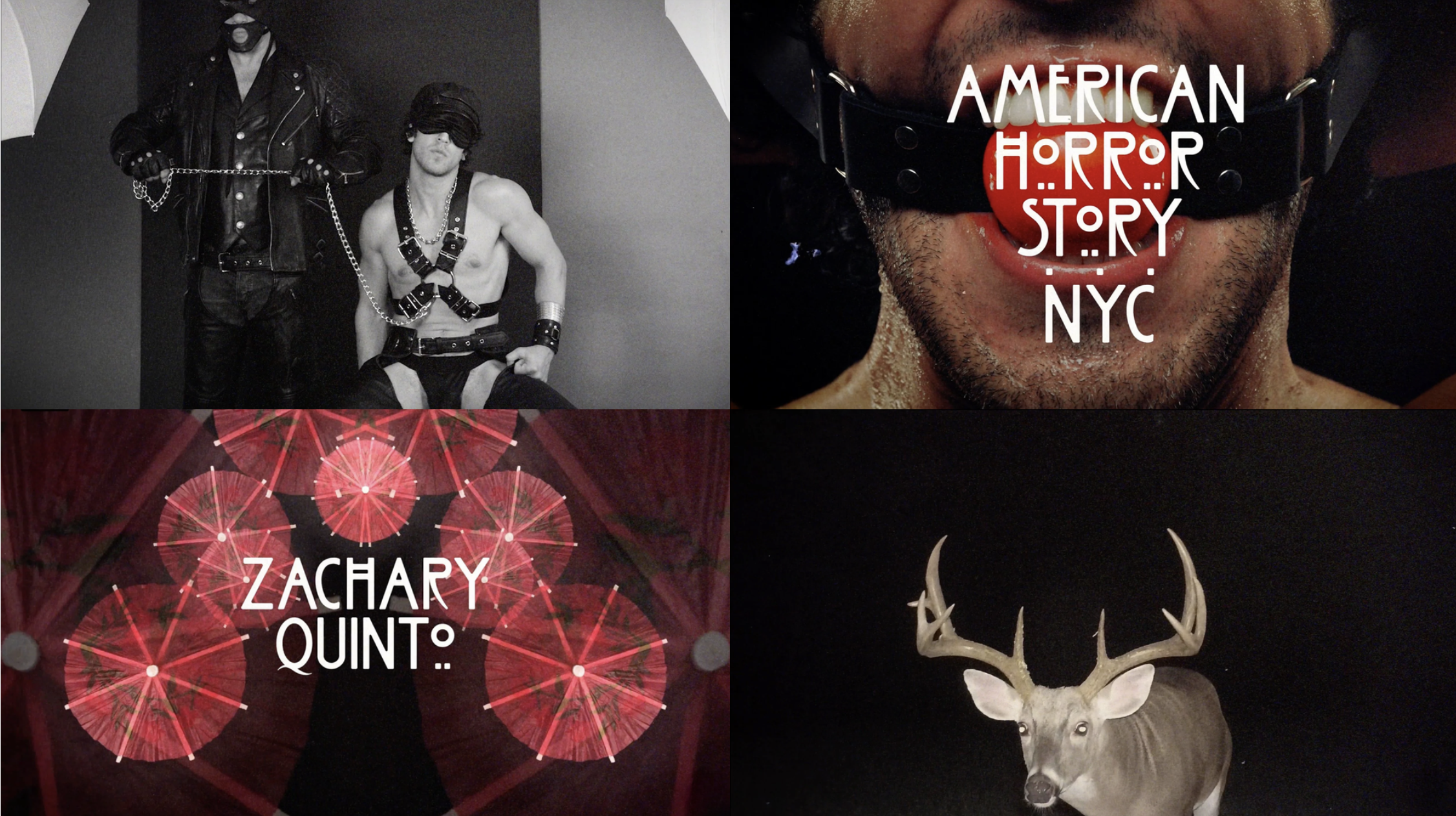
By far the most sombre season, NYC is a poignant exploration of the wide, messy web of trauma left by the AIDS crisis while still retaining the show’s extreme, pulpy violence. In another dynamic sequence that replicates the pace of Red Tide, Cooper juxtaposes imagery to evoke the uncomfortable mixture of queer sexuality and disease. Muscular bodies are quickly replaced with emaciated torsos; a mouth waiting at a glory hole is followed by a microscopic view of a virus replicating.
With sequences for hundreds of films under his belt, Cooper has an eye for picking the right details in a story to foreground in the titles. While Big Daddy is the season’s chief villain, Cooper honed in on the secondary antagonist: the Mai Tai Killer, who spikes gay men’s drinks before murdering them. “There are plenty of shots of leather, but I wanted the umbrella in the Mai Tai to be the primary thread for the sequence. So I distorted it and created some kaleidoscopic imagery where it splits into cells and becomes a multiplying virus.”
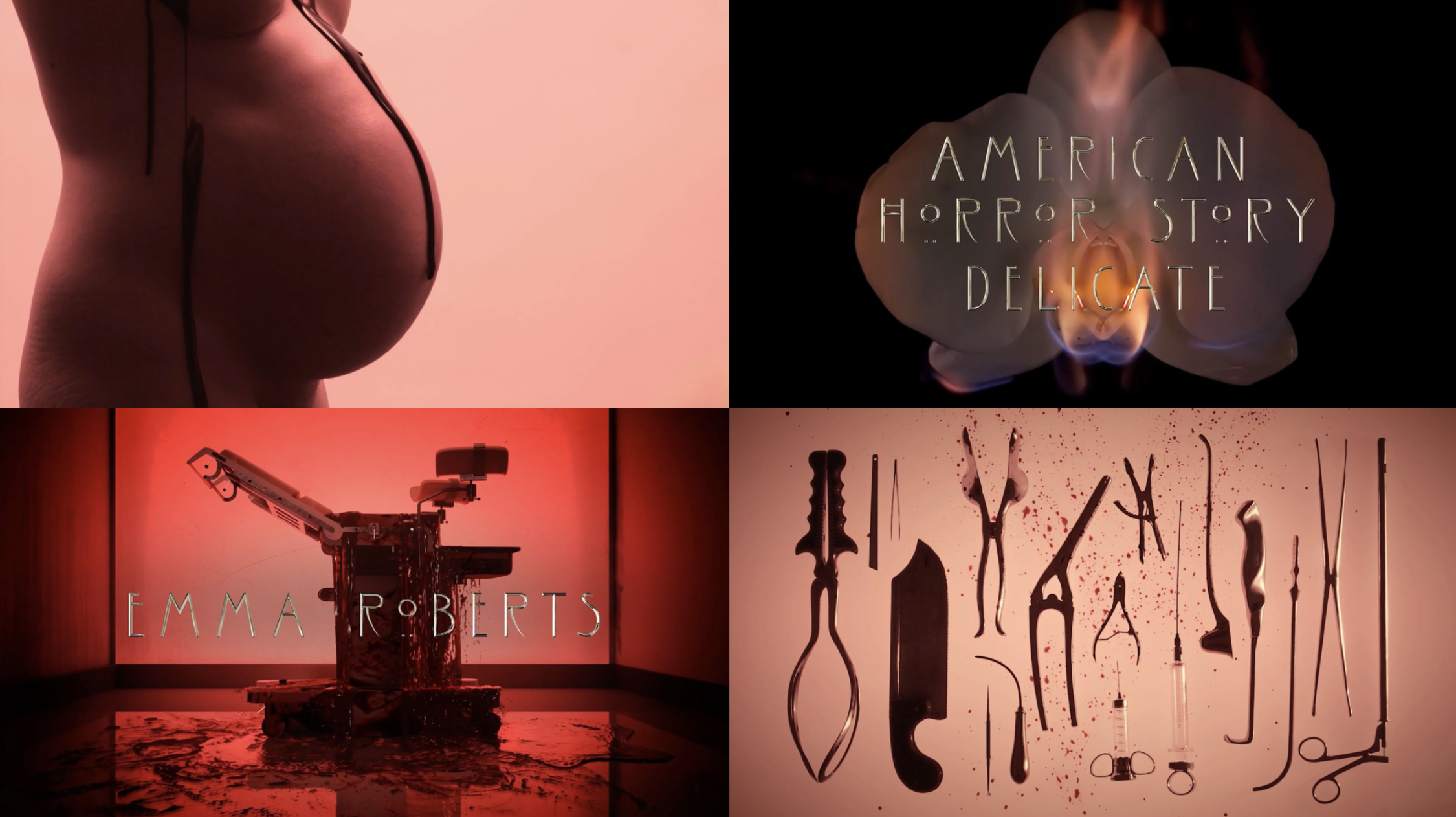
Delictate
FX / Prologue Films
If 1984 is AHS meets Friday the 13th, then Delicate is AHS meets Rosemary’s Baby. The satanic pregnancy plot remains but, naturally, Kim Kardashian has been added to the mix.
While Death Valley’s sequence dipped its toes into pregnancy horror, Delicate sees Cooper jump all the way in. Sharp surgical tools, a hospital bed overflowing with blood, a pram on fire. There’s even a demonic stork. Holding the titles together is its most alarming element: a sinister force rumbling in a woman’s belly.
“I didn’t know if it would be absurd to show a pregnant woman,” Cooper admits. “Would it be inappropriate?” Despite the hesitation, his cinematographer’s wife was pregnant. “So Farhad shot her torso, and everything else was CG. The stirrups, the spider crawling across her belly. There was a lot of animation in that.”
AHS: 13
FX / Prologue Films
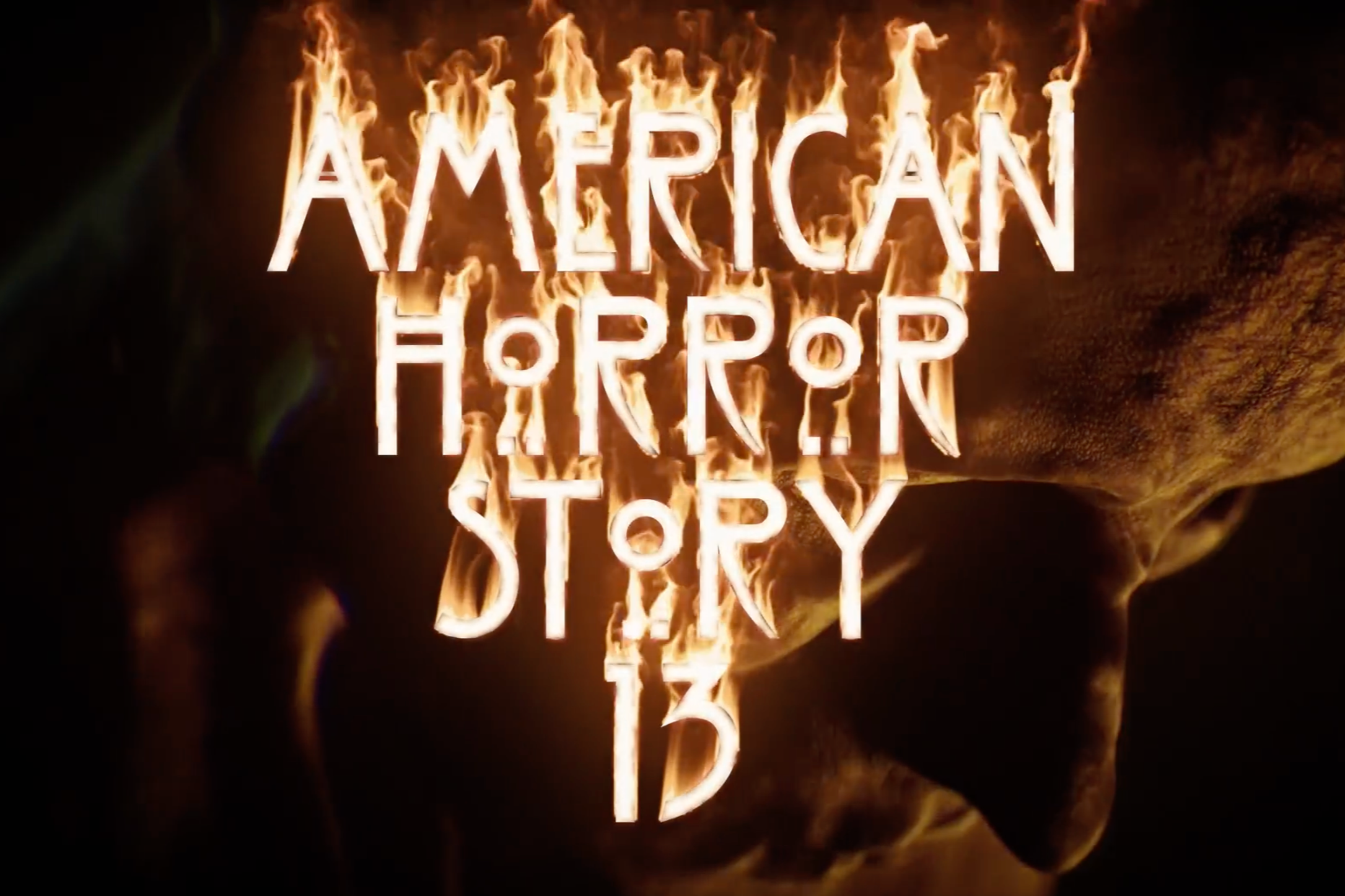
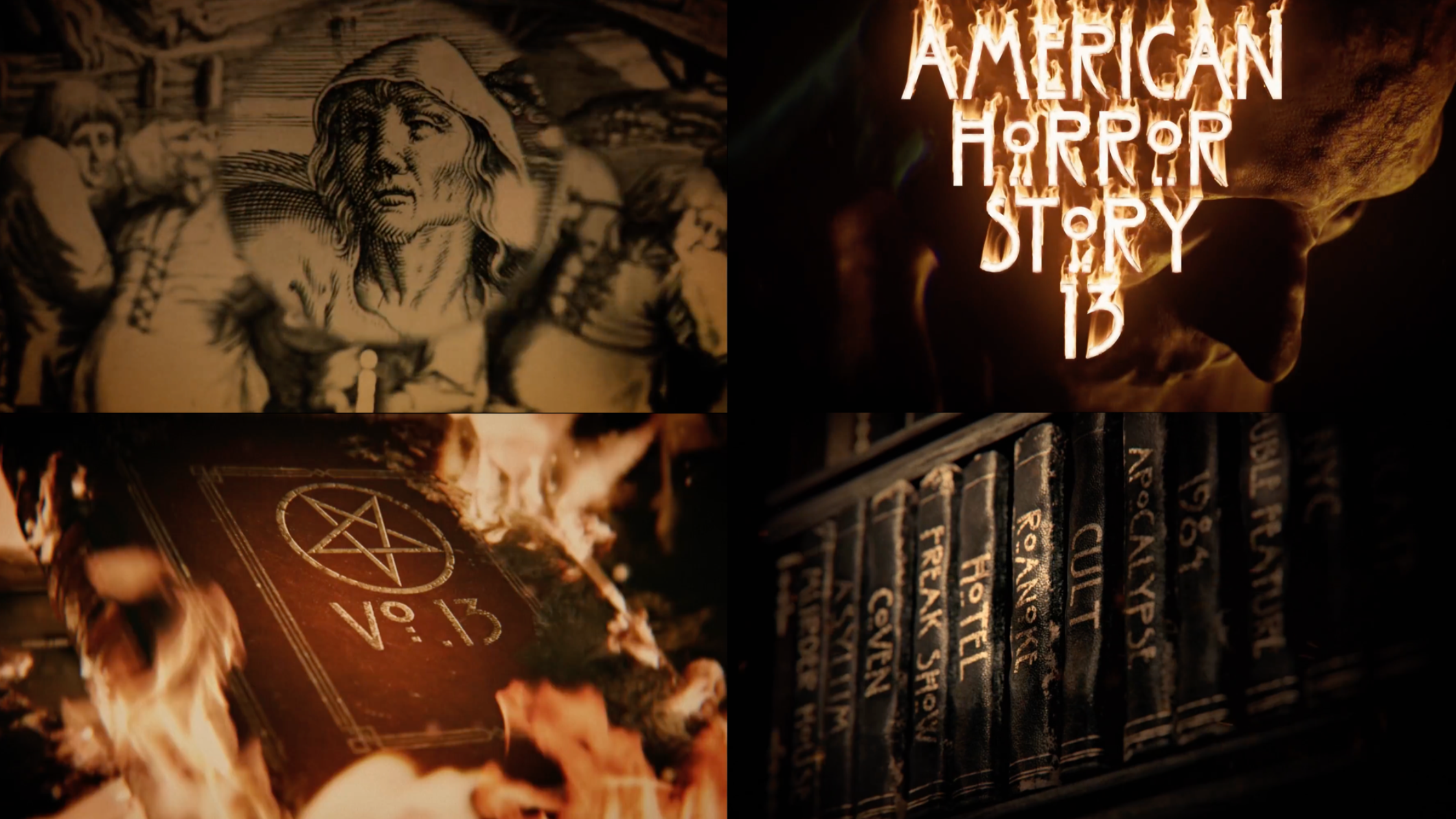
In celebration of the famously unlucky number, Ryan Murphy wrangled all the franchise’s veteran stars (Jessica Lange, Sarah Paulson, Evan Peters, Kathy Bates, Angela Bassett, and more) for a massive crossover event designed as the culmination of all the previous seasons. For Cooper, it was a chance to pay tribute to the most striking images he had captured during his time on the series. “I used my favourite things from previous seasons,” he says, referencing the Infantata’s christening dress, the skeletal winged demon from Coven, and the patient crawling backwards up the stairs in Asylum. “I had a good time cutting in some of the things from Murder House and other seasons. I couldn’t use everything because I shot some of those [sequences] on Super 16, so you can see a lot of grain in them. But we didn’t just want it to be a montage of past seasons.”
To avoid playing like a clip show, Cooper’s wife and collaborator, Kimberly, came up with an eerie hook for the new sequence. “Kimberly had an idea that all these stories were books housed in a demonic library, Satan’s library,” he says. All the previous seasons’ titles are consequently displayed on the spines of an ominous collection, with other standout images including a hairy demon tail and a pentagram on fire, which was shot practically.
While Cooper has a reputation for conceiving some deeply disturbing images, the dark territory can take a toll. “Sometimes it's not good to meditate too much on some of these things,” he reflects. “Having to totally focus on images of the devil and witchcraft — sometimes it scares me. Everybody thinks I’m this dark man, but really, I have to be spiritually fit to [do this job]. I’ll even pray before I do a sequence like AHS, pray that I won’t get sucked into the evil of it all, you know? It sounds silly, but I need to. I don’t want to have an unhealthy relationship with evil things.”
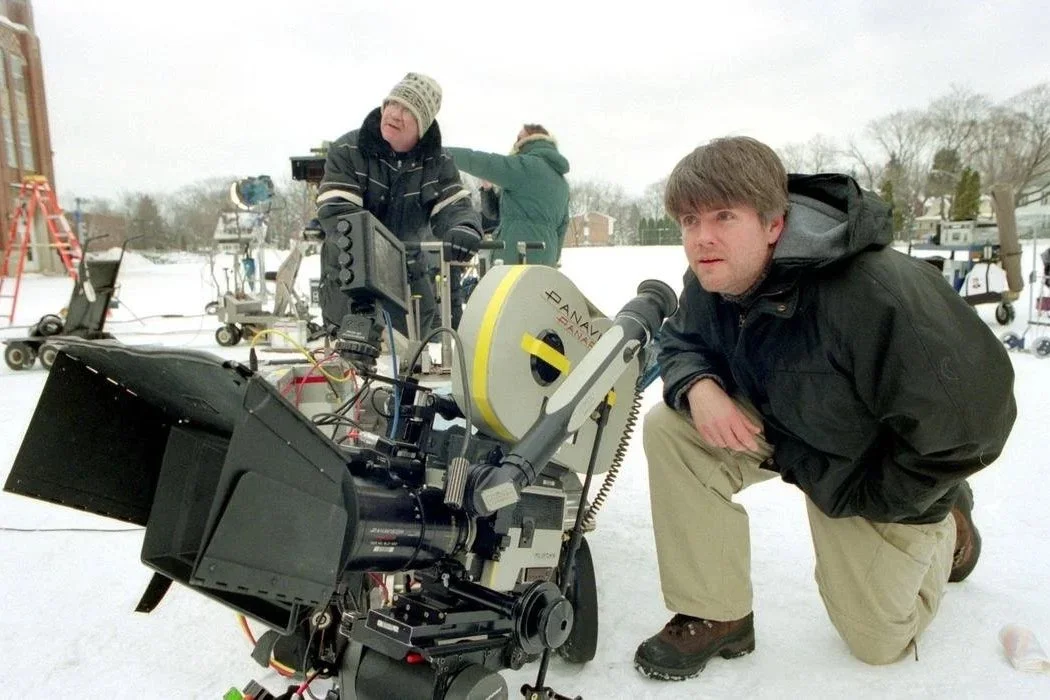
Cooper on the set of his 2001 film New Port South. Photo: Alamy.
Today, Cooper sees more people making title sequences, and more audience attention paid to them. Still, there are drawbacks to modern spectatorship — like the ubiquitous “skip titles” button on streaming platforms. “It’s offensive for a title designer to have that be an option. Maybe it makes sense when bingeing TV, but you wouldn’t skip the title sequence for Se7en. It’s the first scene in the movie! It would be like a button reading, Skip first scene of the film.”
As for American Horror Story, which was renewed ahead of the AHS: 13 finale for a fourteenth season, Cooper won’t let his anxiety around
“God willing, I’m ready — I want to make something a little different, you know?” He reflects after the all-star thirteenth instalment. “Maybe they’ll get tired of me. But I’m game.”