How Primetime Cinematographer David Bolen Turned To Catch a Predator into a Genre-Bending, Psychedelic Thriller
The DP reflects on shaping the look of the hit true crime drama, using a colonoscopy camera for a key scene, and why Robert Pattinson is the most “camera-present” actor he’s ever worked with
by Lana Thorn 15 November 2026
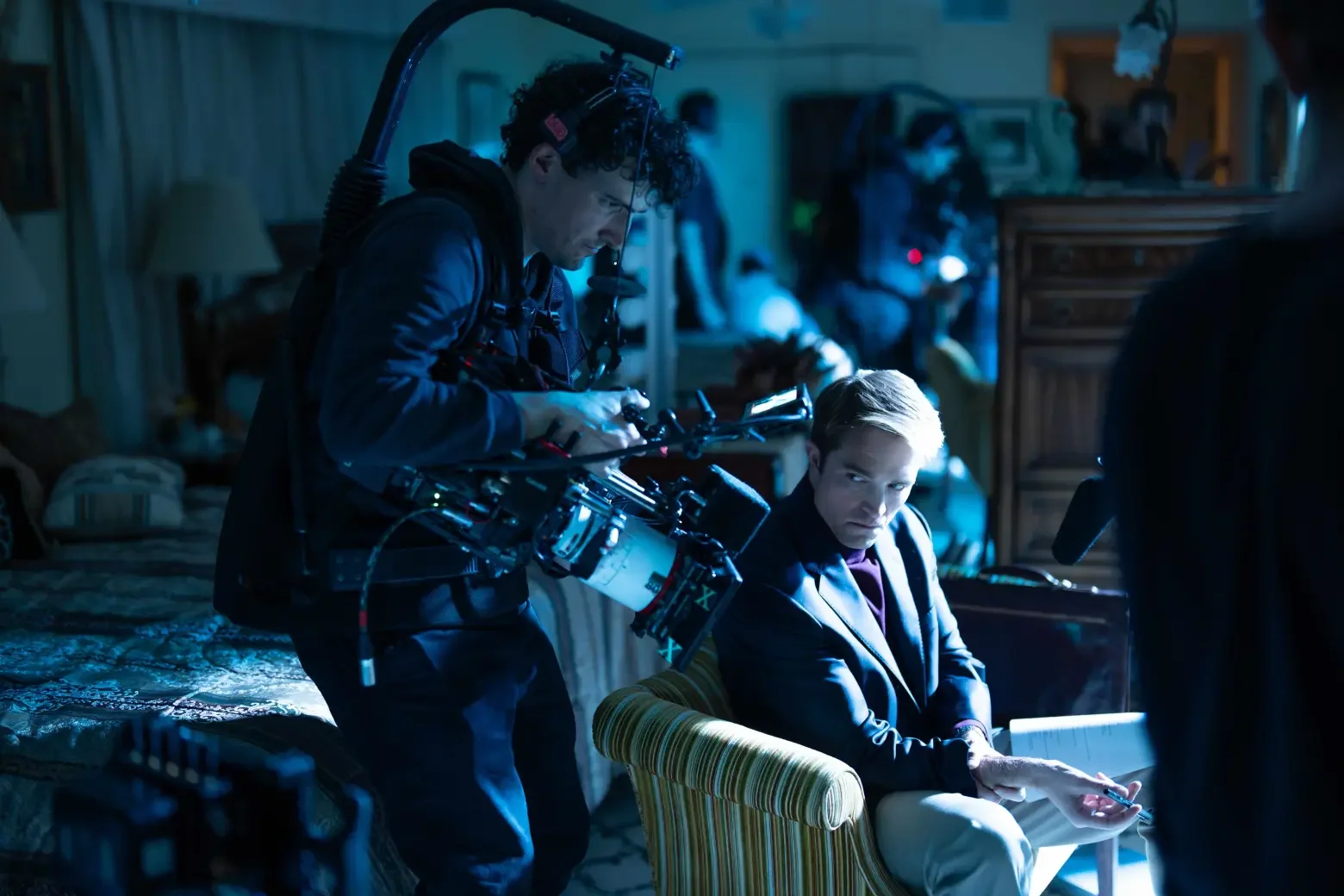
A24
To Catch a Predator is an endlessly fascinating cultural object. Airing on Dateline NBC from 2004 to 2007, the controversial reality TV show centred on sting operations to catch pedophiles blended its grim subject matter with comedic flourishes and the magnetic presence of its host, Chris Hansen. A straightforward biopic wouldn’t work for a figure like Hansen and his singular magnum opus, and cinematographer David Bolen wouldn’t have it any other way.
A hit for A24 since its Venice premiere, Primetime sees the Canadian DP reteam with his longtime collaborator Lance Oppeheim (Some Kind of Heaven, Spermworld) for the director’s first narrative feature. Robert Pattinson plays Hansen, and Bolen captures his wild performance in equally unconventional images that swap the textures of by-the-book biopics for those of a colourful, surreal psychological thriller, using everything from vintage tube cameras to the DV cameras from To Catch a Predator.
While another one of Oppenheim and Bolen’s features, their Elizabeth Holmes documentary You Can See Everything, is already making waves at the US box office ahead of a UK release this Friday, the cinematographer sat down with Phantasmag to unpack the true crime thriller and discuss how he studied the visual language of the original To Catch a Predator series, taking inspiration from Michael Mann films, and why working with Robert Pattinson was “magical”.
Phantasmag: How did Lance Oppenheim first approach you with Primetime, and what excited you the most about the project?
David Bolen: What’s great about Lance is that we've been working together for so long. It’s less this thing of I've got this new project, here it is and more that I hear whispers every day from him. Primetime was something he put in my ear very early in the process, and that gave me time to really develop things with him and figure out the look of it. It's not something that we were rushing to figure out a month before the film started shooting. At this point, Lance had only done documentaries, even though he had had lots of opportunities for narrative films that had never quite worked out. But on this one, he was so determined and steadfast in his conviction to do it. I could tell he was really excited, and that energy went into all the crew members, from me to the composer to the editor.
P: What were those initial conversations like with Lance about the look and texture of the movie, and how did they evolve with the process?
DB: The funny thing about Lance is he's been showing me To Catch a Predator for the past 10 years, without any idea that he would make a To Catch a Predator film one day. The fact that it all happened is still kind of insane to us because when we’d be shooting documentaries and would be exhausted after a 14-hour day, Lance would be like, ‘It’s 1:00am, let’s watch To Catch a Predator.’ And for no apparent reason [laughs]. He’d put it on and force the entire crew to watch.
So visually, the show has been in my mind for quite a while, and that was the main reference point at first. We started to learn very early that they experimented with all sorts of weird cameras and formats, and the show looked kind of different every single episode. So in a way, that liberated us to create a visual style that felt a little bit all over the place in a way. We threw everything at it. There are so many different cameras and formats, and that excited us. On a textural level, Lance and I are both sick of the way movies look right now. Everything lives in this kind of grey, black-and-white, mundane palette. We wanted to fight that urge, and we wanted to create something really colourful and striking and different, you know?
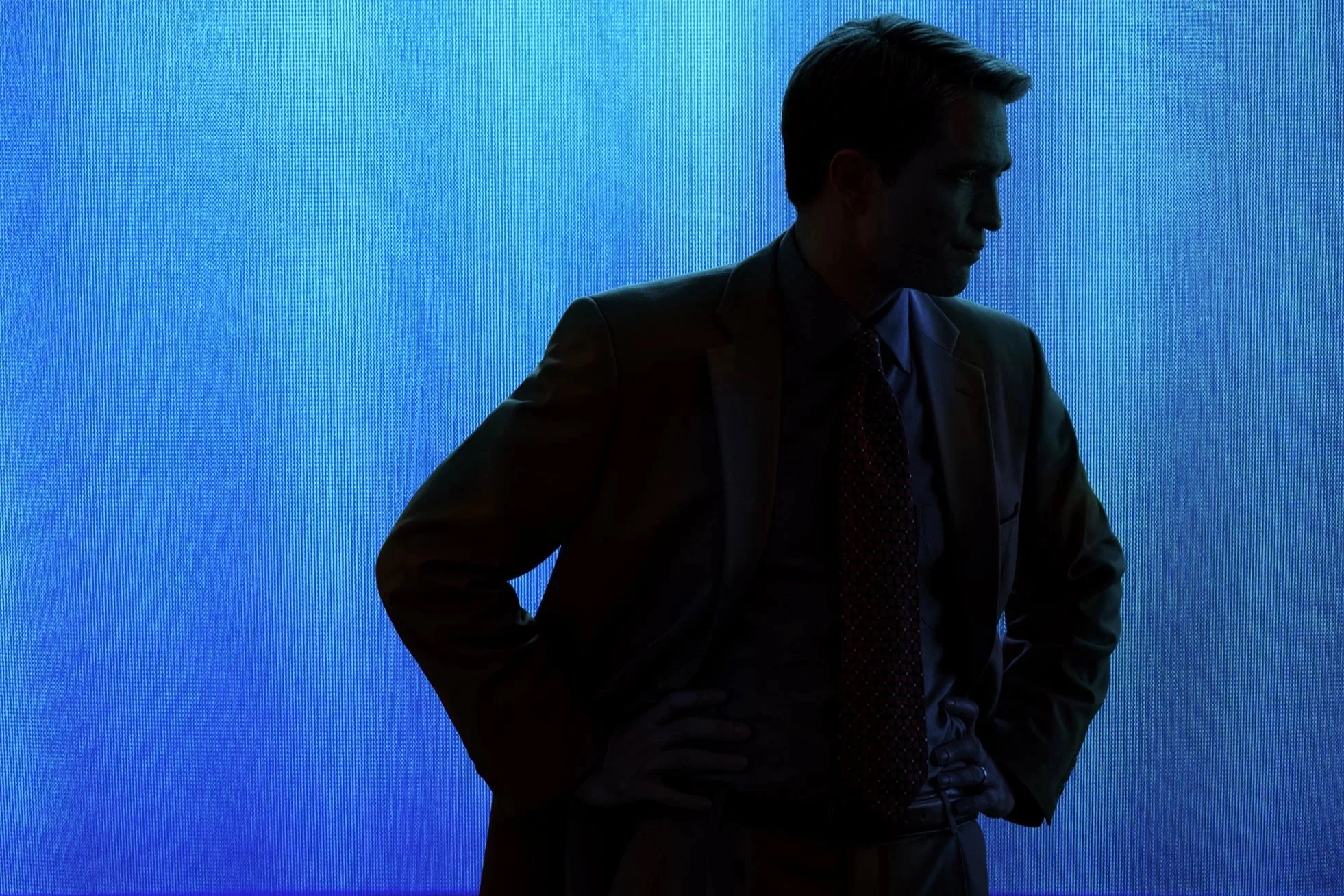
Robert Pattinson as Chris Hansen. Courtesy of A24.
P: You mentioned the multiple cameras. How did you settle on this eclectic line-up, and what value did each of those cameras give you?
DB: I wish I had photos of our production office because Lance and I shared one. People would come in, and they would be like, ‘What the hell is going on here?’ It looked like a mad laboratory. There'd be Alexas [ARRI Alexas, industry-standard digital cameras] and lenses and then DV cameras [camcorders common in the 2000s], tube cameras, and these security cameras. A billion Amazon boxes. It was a complete mess of a place, and we were constantly testing everything imaginable to see what look we liked. Eventually, what we ended up doing was talk to one of the cameramen on To Catch a Predator. He told us one of the cameras he used was the DVX100B, which was the first DV camera to do 24 frames per second. It’s a camera that's very nostalgic for me because I grew up making skate videos on it. So I love that camera, and when I heard that, I went on eBay and bought every single one imaginable. We got eight of them.
That was our main camera to represent the format of the show, and it played as our more objective camera. Within that, we started experimenting with Plumbicon tube cameras, which are these old cameras from the 1980s. They're amazing because they have tubes inside that literally burn if you point them at the sun. So they decay over time, and that became the psychological camera of the film. You see quick flashes of it throughout the movie. Whenever things get really psychological or psychedelic, we use that camera to represent Chris Hansen’s internal psychology. Those were our main experimental cameras, and then we shot on the Alexa, but we really tried to make it as filmic and degraded as possible. We wanted the image to almost feel like it was falling apart. Like at any minute, it could just explode and disappear. So we really distressed the image and made it as textural as we could.
P: When did the idea for the colonoscopy camera come in?
DB: Oh, yeah [laughs]. That was fun. I get a pit in my stomach from certain scenes, and I read in the script, The camera travels through a computer screen and comes out on the other side and reveals this character. I just immediately got nervous because I was like, Oh, God. There's no way Lance is gonna wanna do this with visual effects. We started looking at weird microscopic cameras that we could use to travel through weird spaces, and I landed on the colonoscopy camera. I showed it to our production designer, Alex [DiGerlando], and he was like, ‘This looks so crazy. What is this?’ He started getting excited and built all these weird light rigs for it. It’s funny, people are always asking, ‘Was 2001: A Space Odyssey a reference for that?’ And that’s giving us way too much credit.
P: What was your collaboration like with both the production designer and the other departments to shape the look of the film?
DB: People always kind of think of directors and DPs as these masters of the image and that we control everything. But no, it's a big collaboration between me and the director, the production designer, the costume designer, hair and makeup — all those things. In creating an image, a cohe- cohesive image, you have to have all those things working in tandem. So Alex is our production designer, and he was a hero of ours, you know? He did True Detective Season 1, which to me is one of the best TV series of all time. He brought in the magic and found us these incredible locations in New Orleans that felt like homes that belonged to vintage photographs.
Then Alex Bovaird, our costume designer, put so much care into everything. Early on, she came by my office and was like, ‘What do you think for Decoy Dan? What's his colour palette?’ We both were thinking about these themes of innocence, so we decided he should always be wearing red. He's got this iconic red sweatshirt, and then we would pop that colour [in post] and make it extreme so that he’s always this glowing figure in every space. That comes from an early collaboration between me and Alex. So I love collaborating with departments, and people don't understand that, as a DP, I'm only as good as the production designer and the wardrobe and all those things coming together.
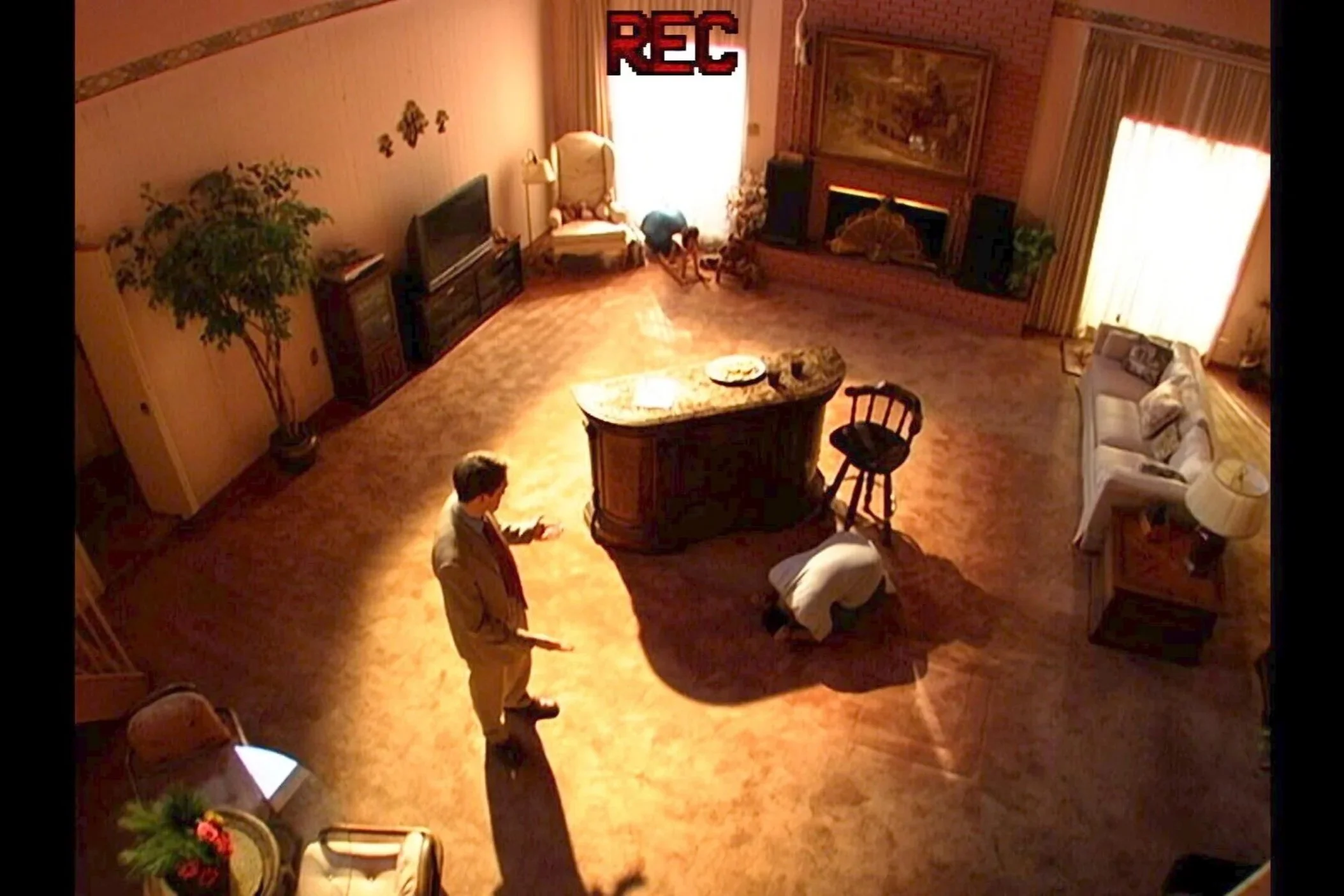
Bolen used the same DV camera that To Catch a Predator filmed with, along with security cameras. Courtesy of A24.
P: I was just talking to Peter Deming for an anniversary piece on Mulholland Drive, and he was saying how his relationship with David Lynch was very free-flowing, and they often made last-minute decisions. But Jarin Blaschke, for example, talks about how his work with Robert Eggers is extremely meticulous. Where do you and Lance fall on that spectrum?
DB: I'm someone who trusts my intuition, but I also have too much anxiety to go in with zero plan [laughs]. There's value to going in with a plan, but Lance is this amazing... He’s one of the most energised people I've ever met, and he constantly has ideas, almost to the point where he can't stay focused on one at any given time. So if you try and make a shot list with Lance, that will happen for about six minutes, and then he'll get inspired by some random photograph, and he'll be like, ‘Oh, my God, I got some wardrobe ideas. Let me call Alex quick.’ He’s constantly in this flow state of ideas forming, so it's very hard to create meticulous plans with him.
What Lance is doing is constantly communicating, so that when we do get on set, everyone is ready for the chaos. And what's beautiful about Lance is that, if you go in and embrace that chaos, it leads to some magical things. So generally speaking, I would have a shot list. And generally speaking, we would throw that shot list out every day, and feel it out with the actors and explore. What's great about [Robert] Pattinson is he's not a rigid actor either. He's experimenting and trying to push it to the very max. He doesn't want to give a standard performance, and he doesn't want to just hit a mark. With an actor like that, you’re doing a disservice if you just say, ‘Go from here to here and say your line.’ Instead, it’s: ‘Let’s experiment, and let's create something really special together.’
P: Speaking of Robert Pattinson, he delivers such a wild, gonzo performance. Especially when your approach to cinematography is so experimental, what was your collaboration like with Robert, and how did you go about capturing that performance?
DB: I truly say this from the bottom of my heart: Rob is the most camera-present actor I've ever worked with, in the sense that he really understands that you are acting within a frame. Whether it's a wide shot or a close-up, he changes his performance based on what the shot is. And oftentimes, Rob, if you're looking at shots of him from behind in the movie, there'll be a monitor right in front of him that he's looking at, and he's trying to understand the frame.
One of the opening shots in the movie, that’s pushing in from behind him, is Rob shirtless with all this Vaseline on his back. He looks really sweaty, and he's contorting his back in this really amazing way, and that's only possible because Rob has a monitor right in front of him. He, in real time, is trying to make his back look as wild and crazy as possible. Oftentimes, when we do a close-up of him, I'm right there with him, and I turn the monitor to him, and he takes a look, and he sees where he falls in the shadow, and he sees where he comes into light. Then during his performance, he’ll come into that light at the perfect moment or the perfect line. So you start to understand why, in films like The Batman or The Odyssey, his performance feels so precise to the frame, and it's because he has such an awareness of the camera. As a DP, that's just magical because it makes my work exponentially better.
P: I’ve heard that everything from Manhunter to Casino to The OC inspired this film aesthetically-
DB: The OC — wow. I love that. Who said that? I wonder if Lance said that [laughs].
P: Yeah, it was Lance [laughs]. What images did you have in your look book, and what were some of the most useful influences from there?
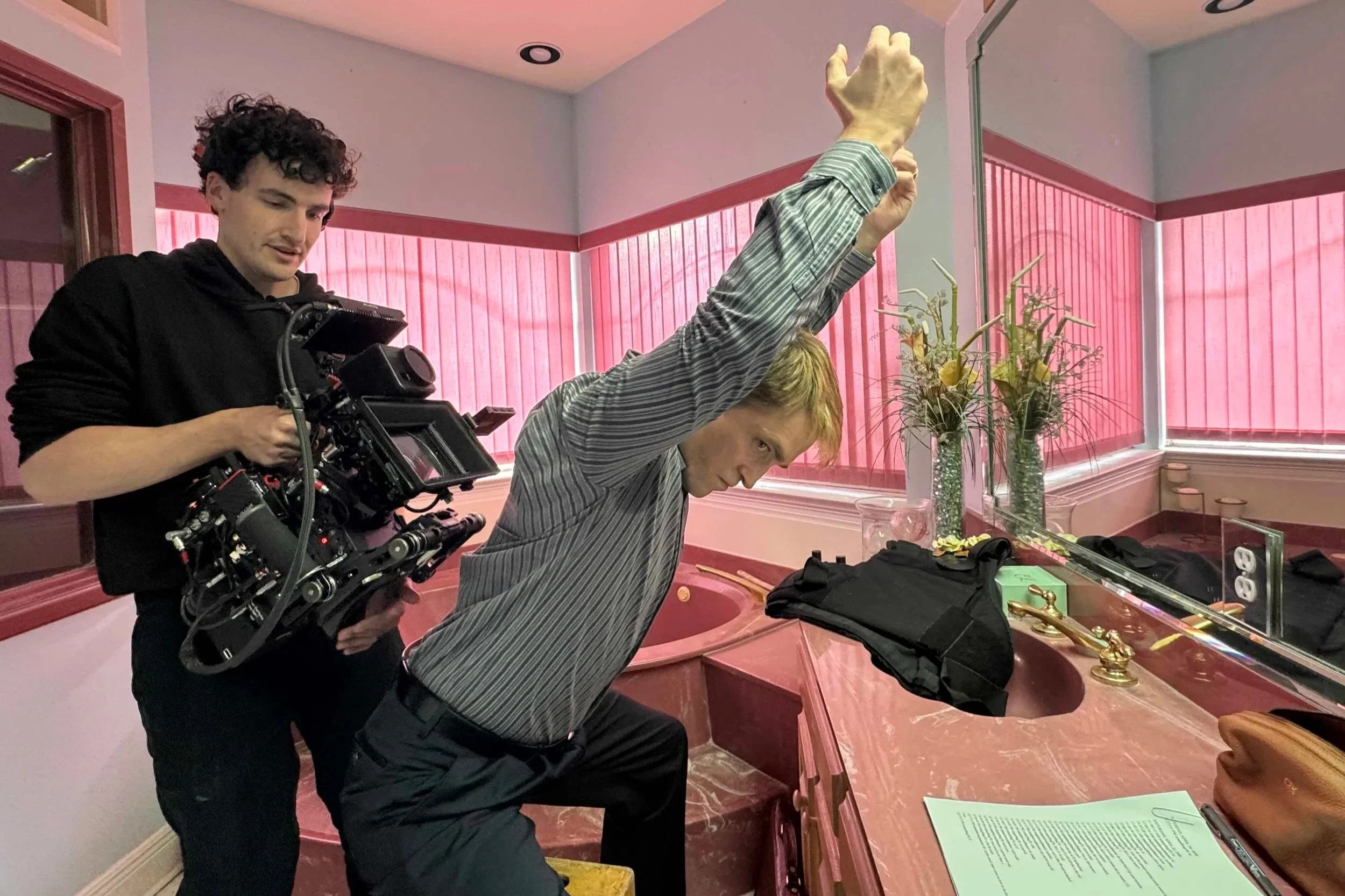
Bolen (left) and Pattinson (right) on set. Courtesy of A24.
DB: Our favourite photographer is Larry Sultan, and he inspired our first feature together called Some Kind of Heaven, and in many ways, his photo series The Valley was a huge inspiration for this film. He shoots in these really colourful spaces, but he captures sad moments in life and profound moments. That's always been an inspiration to me and Lance: just because a story is disturbing or sad doesn't necessarily mean the lighting and the image have to be dark and moody. There's something interesting about sad things happening in a vibrant or bright frame, and that contrast has always been inspiring to us.
So Larry Sultan gets the credit for that, and then Michael Mann was probably our number one influence for this. Manhunter, Insider, Heat — all those films had a profound effect on this. I think specifically what inspired Lance is that Michael Mann, especially in that time period, cared very little about rules. He didn't care about the 180 line. He didn't care about consistent lighting. He didn't care about lights feeling unmotivated. He just went for it, and he did what felt emotionally right for the story and not necessarily what was physically right for a space. That really let me, as a DP, be experimental with the lighting and the colours. For example, there could be no reason to use a red light in a scene, but we would go for it because it felt right emotionally. And Lance is amazing because in the production office we had a little movie theatre, and every single night he'd just be showing a new film to the crew. It created this environment where everyone just felt enabled to do their craziest, most insane work.
P: You’ve talked about watching To Catch a Predator. When you were doing research for the movie, what were you looking for specifically in the episodes?
DB: The main thing I'm just trying to capture organically is the positioning of the cameras and how it makes the show feel. It’s technically a hidden camera show, and yet we were always amazed that a lot of the frames in the show felt really artistic. Sometimes you watch To Catch a Predator, and a lot of it’s just medium shots, but then they do these incredible, beautiful wide shots of someone coming into a house, and it's haunting. Even when we were doing the TV frames, it was a goal of ours that they felt artistic and meaningful and not just bland.
P: Primetime descends a bit into surreal psychological horror territory in the second half of the film. How did you go about capturing that tonal shift, especially when Chris is having those flashback scenes of the masked figure?
DB: It was so fun to play with that stuff because most traditional biopics are so straightforward. There were a lot of subtle things I did from the first half to the second half. For the first, we shot on spherical lenses, and for the second, we changed to anamorphic lenses. As the film progressed, I was distressing the image even more. So we started making it more grainy, and the colours got more sickly in a way. We played much more into blues and greens. I wanted it to always feel like these monitors [the characters] were looking at were almost absorbing them. As much as possible, when I could just light scenes with monitors, I wouldn't even bring in film lights. There was this feeling that the monitors were consuming them and making them go crazy.
Then we started leaning a lot more into that Plumbicon tube camera. Whenever things weren't feeling right, or they weren't feeling troubling enough, Lance would be like, ‘Bring out that Plumbicon tube camera,’ and we'd start experimenting. I never really thought it would feel like a horror movie in any way, but it's so funny how many people bring that up. For me, the goal was always just that I wanted to get into the internal psychology of these people. By the second half of the movie, they're all descending into this madness, and I wanted to depict that visually.
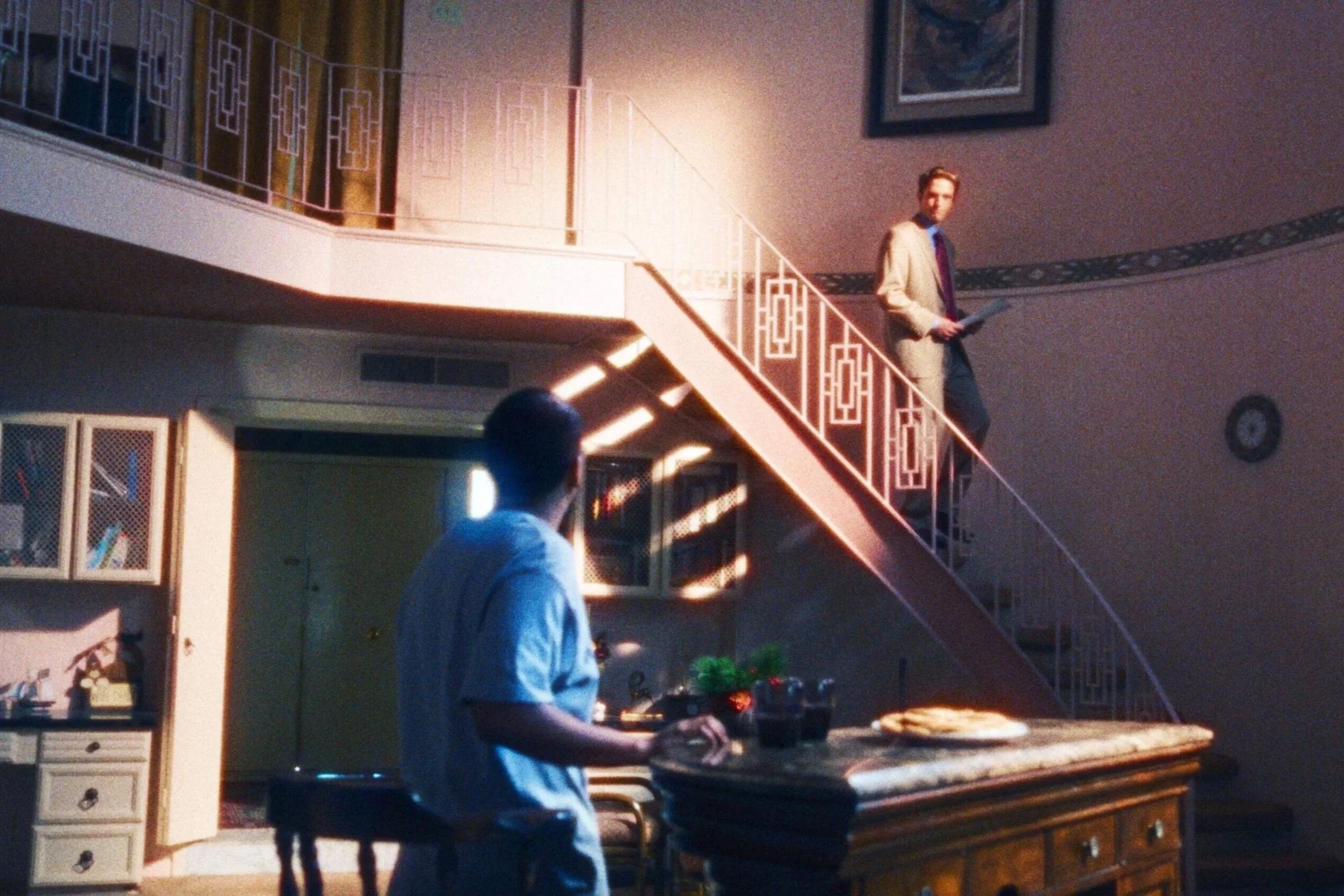
Chris Hansen (Robert Pattinson) catches a predator (Tony Revolori) in the film’s opening scene. Courtesy of A24.
P: It's funny you mentioned that because, when I saw the film at Venice-
DB: Oh, that was a crazy screening. I was worried no one understood the jokes because they were all Italian.
P: They’re like that with everything. At the press screening, everyone was laughing much more than at the premiere.
DB: That’s so interesting. I have never been so terrified in my life. In a tux, overheating as this Italian audience watches our film. It was such an intense process.
P: It was interesting because when we got out [of the press screening], everyone was saying, ‘I didn't expect there to be so many horror elements in the second part.’
DB: Yeah, I know it's not expected for a Chris Hansen movie. Also, the India sequence we actually shot in Sri Lanka, and that was so fun: to be shooting a To Catch a Predator film, and all of a sudden, I'm in a remote region of Sri Lanka in a cave. I was like, What movie are we making here?
P: This may be a hard question, but do you have a single favourite shot in Primetime?
DB: Honestly, I do. And it’s a shot where I probably ruined the day because I took so much time. We were so insane about getting it perfect, but there's a shot in the second half of the film where Chris Hansen is at his low point, and he's in one of the sting houses. There's this giant, massive window that takes up the entire wall, and there's a rainstorm outside, and Chris is silhouetted against this, looking out into the abyss. It was a really hard shot to pull off because it was rain and lightning and effects, and we were all on overnights and losing our minds. But it's something that me and Lance really committed to. We wanted it to be one of the special images of the movie. That one holds a special place in my heart just because we really fought to make it happen.
P: Another potentially hard question, but as a cinematographer, what are your all-time favourite films that continue to inspire you the most?
DB: Me and Lance’s favourite movie, and this is where we first bonded together, is a film that is very divisive. It's Vanilla Sky by Cameron Crowe, and to me, in many ways, it’s a spiritual companion to Primetime because it has so many normal elements and then it has these psychedelic, crazy elements to it. That film's huge for us visually. I'm so blown away by it. Another film that has had a massive influence on me is Donnie Darko. I love the colours of that film. I love how extreme it is. I love how blue it feels, and that's a huge reference point for Primetime. Then my favourite Michael Mann film is Heat. There’s such an energy to the way he shot that film.
P: I love that you mentioned Vanilla Sky. I feel like it's also a very underrated Cruise film.
DB: Super, super underrated. It's such an amazing performance, and John Toll shot it. Visually, it’s just one of the most beautifully shot films.
P: Between Primetime and now You Can See Everything, you've had two massive movies released in the span of three weeks. Even though one is a narrative feature and the other is a documentary, they're each very self-reflective projects, investigating ideas around the power of the camera as an object of truth. Can you speak on that through line between these projects, which are clearly strongly resonating culturally?
DB: Lance is interested in the process of creating television and creating documentaries and all those sorts of things. For me, if you go through any of our projects in the past, all of them go into these themes, and with Primetime specifically, he is so intrigued by the idea of what a camera does to a person and how people react differently when they know there's a camera involved versus when they think there's nobody recording them. That's an interesting idea in Primetime specifically because it's just that these people behave so terribly when they think there's nothing recording them, and then when they find out someone is, they completely change their tune. That's normal in all documentaries. Capturing any form of pure objectivity is an impossible thing, so I think Lance is interested in that relationship between the camera and the human and what it does to human psychology.
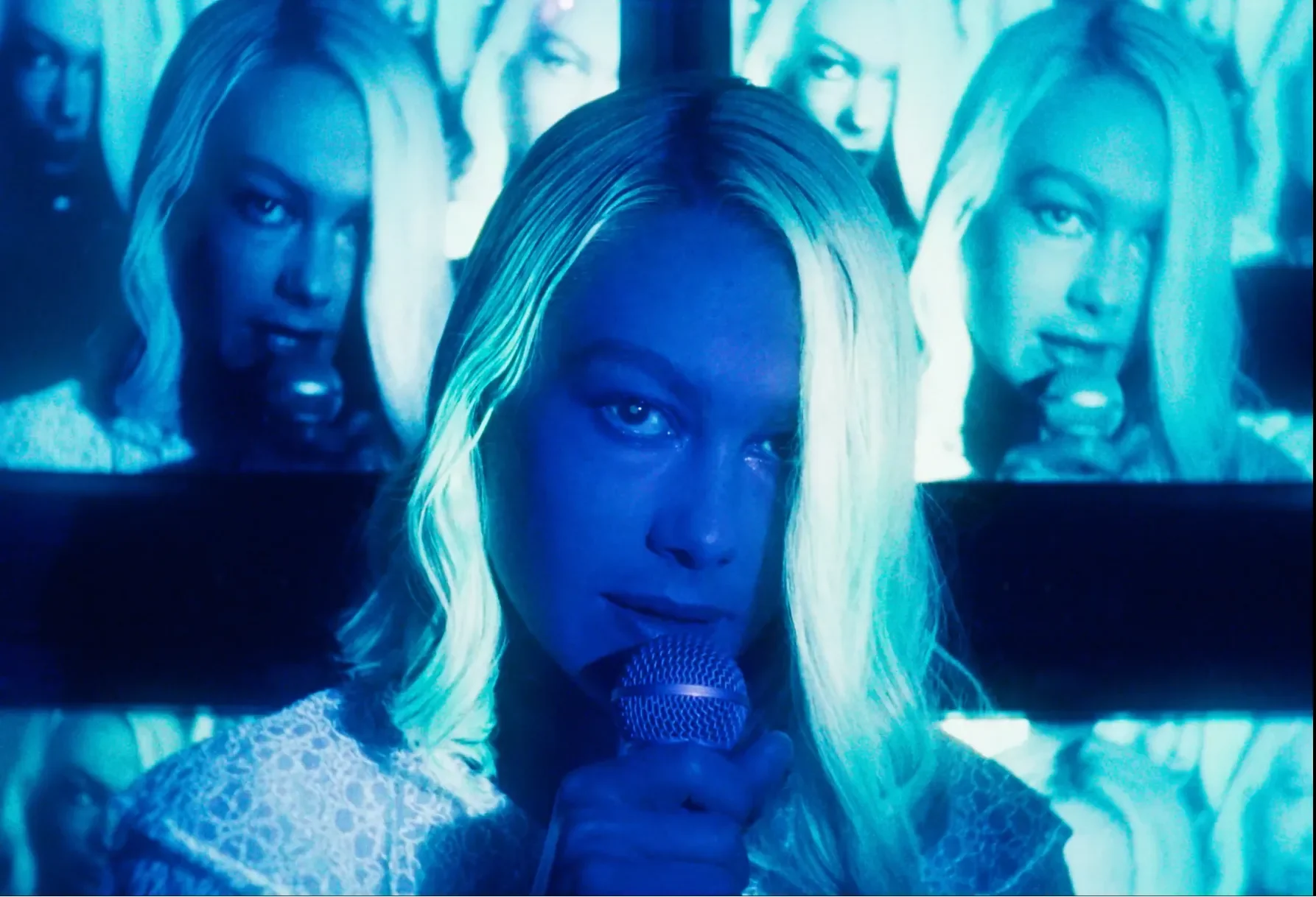
Primetime star Phoebe Bridgers’ Sound Check at Cherry Lane short film, shot by Bolen and directed by Lance Oppenheim
P: On the topic of discovering they’re being recorded, do you have a favourite Chris Hansen reveal?
DB: Oh my God, there are so many. He comes up with some of the craziest intros. They’ll be like, ‘Could I get a Coke?’ and then he's like, ‘Is Pepsi okay?’ It's so crazy that that’s the moment people realise that their life is over. But the classic ‘Big night planned’ is always my favourite [laughs]. Chris is a genius in so many ways.
P: You worked with Lance again when you shot Phoebe Bridgers' Sound Check at Cherry Lane in line with the release of the film. How did you approach that project and pairing it with some of the textures and aesthetics of Primetime?
DB: That was the most fun, also just because we're massive fans of Phoebe's music. Phoebe's become a really good friend over the years, and Lance used to live with Phoebe, which is wild. But it was awesome because Phoebe is an artist who is like Rob in many ways. She wants to push the boundaries and create things that are experimental and beautiful and different. So she enables us to do all that stuff, and we wanted it to be a spiritual companion of the film. I made the first call to my first AC and asked, ‘Are you available?’ He came from New Orleans for the shoot and brought back all of our favourite tools.
So we had a bunch of DV cameras, an Alexa, and the tube camera. We found a new tube camera that was crazy because, for the last song of that sound check, you can see we're filming, and it almost feels like the camera is bleeding. As you move the image, the light bleeds in the image. I wanted it to feel like the video camera and the monitors around her were consuming her as a person, and that's what's so cool about that song [“On Video”, which plays during the end credits of Primetime] as well. So yeah, it was great to get completely experimental because so often you work with artists where all they care about is looking good, and Phoebe is an artist that's like, ‘I don't care if I look good or not; I just want you to make something cool and unique.’
P: With audiences in both the US and UK having had the chance to digest Primetime and share their thoughts, is there an element of your work or the wider film that you wish viewers would notice more?
DB: It's funny with Primetime because I think it goes back to what we were talking about with image creation. Generally speaking, there are a lot of people who are like, Wow, Lance and David created these incredible images. But it was Lance, David, Alex Bovaird, my gaffer, Chip [Carey], my first AC [Zachary Blosser]. So many people are involved in image creation, and I'm truly a believer that as a DP — yes, I’m in charge of the framing and the lighting — but so much of what goes into a frame belongs to those other collaborators. So I always want them to get more credit than they do.
P: You've worked on documentaries, thrillers, and music videos. Is there a genre or kind of project you're excited to explore next?
DB: There are so many things, and Lance has so many ideas. He's a treasure trove of potential projects. Every day, Lance is calling me, saying, ‘Did you hear about this thing happening in this random country?’ or ‘Maybe we could just jump on a plane quick.’ In school, I majored in film, but I also majored in history, and I think my goal would be to make a Kubrick-style historical film, like a Barry Lyndon-type massive war epic. To do that with Lance would be the most fun thing. How does Lance Oppenheim create a historical epic? What does that look like?
A lot of historical epics look the same: they’re shot multi-camera and have giant camera moves. They lean into these big lighting setups, and it would be so fun for Lance to make a psychedelic version of a historical epic. Marie Antoinette is the closest thing that has come to that, but to do something like that with Lance would be a dream project.
Primetime is now available on Digital in the US and playing in cinemas in the UK.