“I Can’t Listen to Any More True Crime Podcasts”: Juliette Gariépy on Red Rooms
The Quebecois actress reflects on her breakout role in Pascal Plante’s psychological thriller
by Lana Thorn 30 November 2025
Photography Lawrence Fafard Hair&make-up Miles Petrella Styling Patou Graphics Jack Rogers

Dress KNWLS Gloves La Collection
When I meet Juliette Gariépy over Zoom in September, I’m already strangely familiar with the image on the screen. Her dark web-obsessed, sociopathic protagonist in Red Rooms (Les Chambres rouges) spends much of the film staring intensely at a computer monitor. Fortunately, wearing a purple sweater and sipping on a Stanley cup, she’s bubbly, warm, and ever-so-slightly jittery ahead of her first-ever theatre performance later today (she’s starring as Herakles in an adaptation of Anne Carson’s Autobiography of Red at Montreal’s ESPACE GO). In summary, it’s not the face of a woman who’s seen a snuff film.
A hit on the 2023 festival circuit, Red Rooms is a disturbingly relevant, Fincher-esque horror thriller that dissects our attraction to violence and true crime in the digital age. It follows Kelly-Anne, a Montreal-based fashion model who becomes obsessed with the trial of Ludovic Chevalier, a man accused of killing and torturing three teenage girls. What’s more, the crimes were live-streamed for a paying audience in online spaces known as “red rooms”. Unlike her friend Clementine (Laurie Babin), Kelly-Anne is no mindless serial killer groupie, and Gariépy keeps us guessing as to what really fuels her interest in the case with a sensational performance that earned her the Prix Iris for Revelation of the Year at the Quebec Cinema Awards.
Over the past year, thanks to excellent word of mouth and streaming releases on Shudder in the US and BFI Player in the UK, the film has continued to excite and horrify viewers around the world. It has also kick-started Gariépy’s career, who next stars in the romantic comedy Mile End Kicks and Jaume Collet-Serra’s survival thriller Play Dead. Looking back on her first major role, Gariépy calls me from her flat in Montreal to discuss the culture of true crime fanatics, the complexities of playing an anti-hero, and why she’s tired of films about the murder of women.

Dress Patrice Blais
Phantasmag: In many ways, Red Rooms is about our attraction to horrific images. Do you remember the first horror film that terrified you?
Juliette Gariépy: Orphan. I remember being freaked out with my friends and absolutely loving it. We started watching more, and it was always this cool adventure to go to the video rental store, choose a movie, and come back home to get really scared. Orphan opened the door to that world for me, and I really enjoyed having a crazy female lead onscreen.
P: It’s such a modern classic. When did you realise you wanted to be an actor?
JG: There was this series of books about a young girl in Quebec called Aurélie Laflamme, and I found out they were doing a movie. I was obsessed—both with the story and with the idea of bringing it to life. I asked my mom if I could audition, and she was like, ‘No, you’re a kid.’ I was really mad, but later I went on my own to try out for some commercial because my friend’s grandma was a casting director. Eventually, my mom gave in, and I auditioned for the Aurélie Laflamme film. I didn’t get it, but the experience sparked something in me.
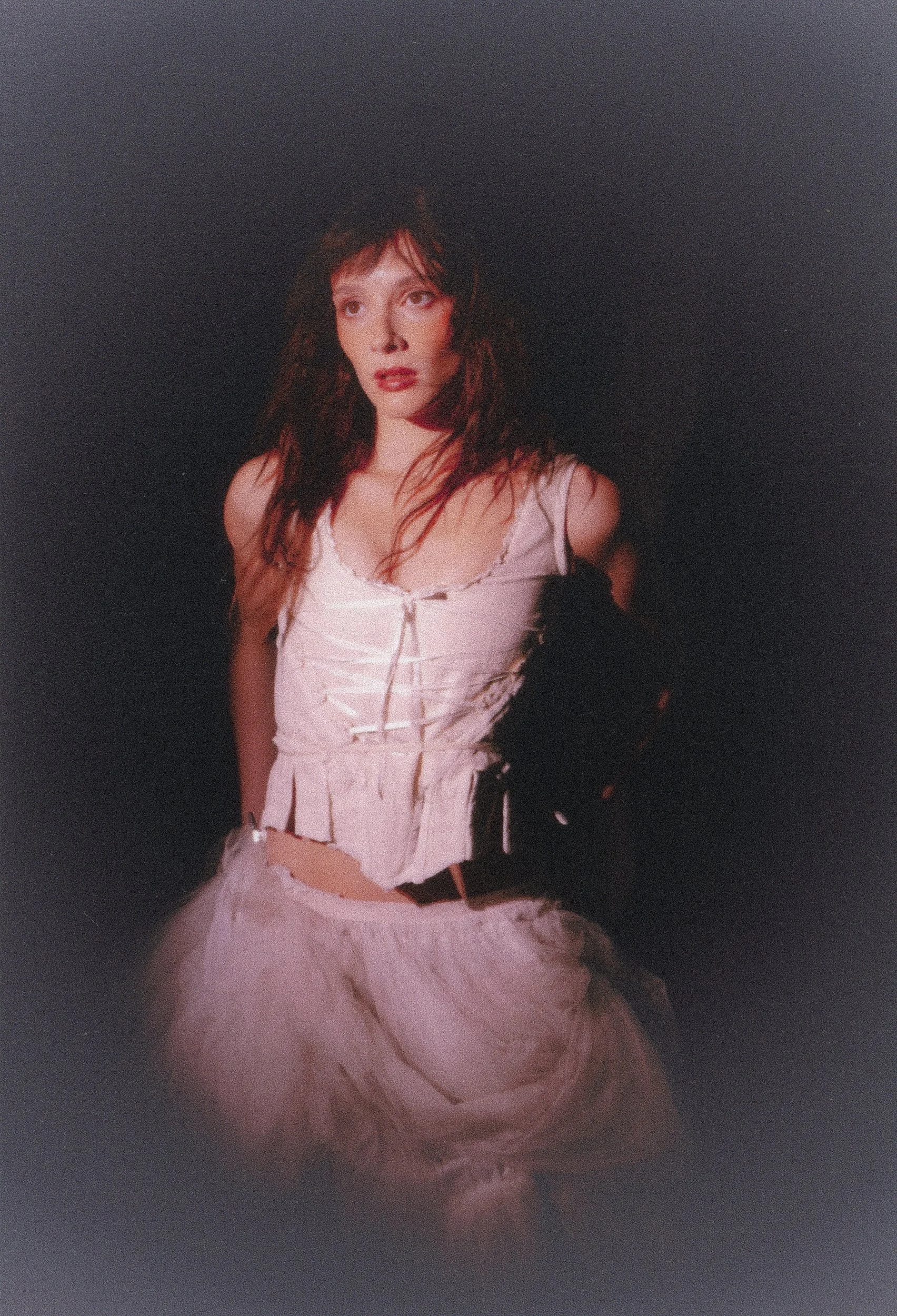
Full look Le Grand Costumier
P: Your dress for TIFF premiere of Mile End Kicks was decorated with the words, ‘My body is a machine that turns my film career into my whole personality.’ What does that phrase mean to you
JG: I wanted to do something bold, where people would have to stop, look, and read. TIFF is huge, and I wanted to be seen, to do a little stunt for myself. I thought, ‘What does it mean to say that cinema is my entire personality?’ Is it a bad thing? Because it’s true, I think about it all the time. And you have to sell yourself. My Instagram isn’t completely personal because some producer who saw Red Rooms will look me up online. Actors have to be interesting and mysterious. It’s not healthy all the time, but I do feel like it’s becoming my whole personality. It’s complicated, but that desire to be wanted and chosen—it lives in me all the time.
Also, I think everyone in this industry has to be a little obsessed with cinema. But then again, that will probably change because now we’re consuming other media, and it’s harder to get people into theatres. Everyone saw Weapons, but still.
P: What did you think of Weapons?
JG: I loved it. But you know what I liked even more? Bring Her Back. That was fucking triggering. It was a beautiful depiction of grief. And Weapons was more of a fun ride.
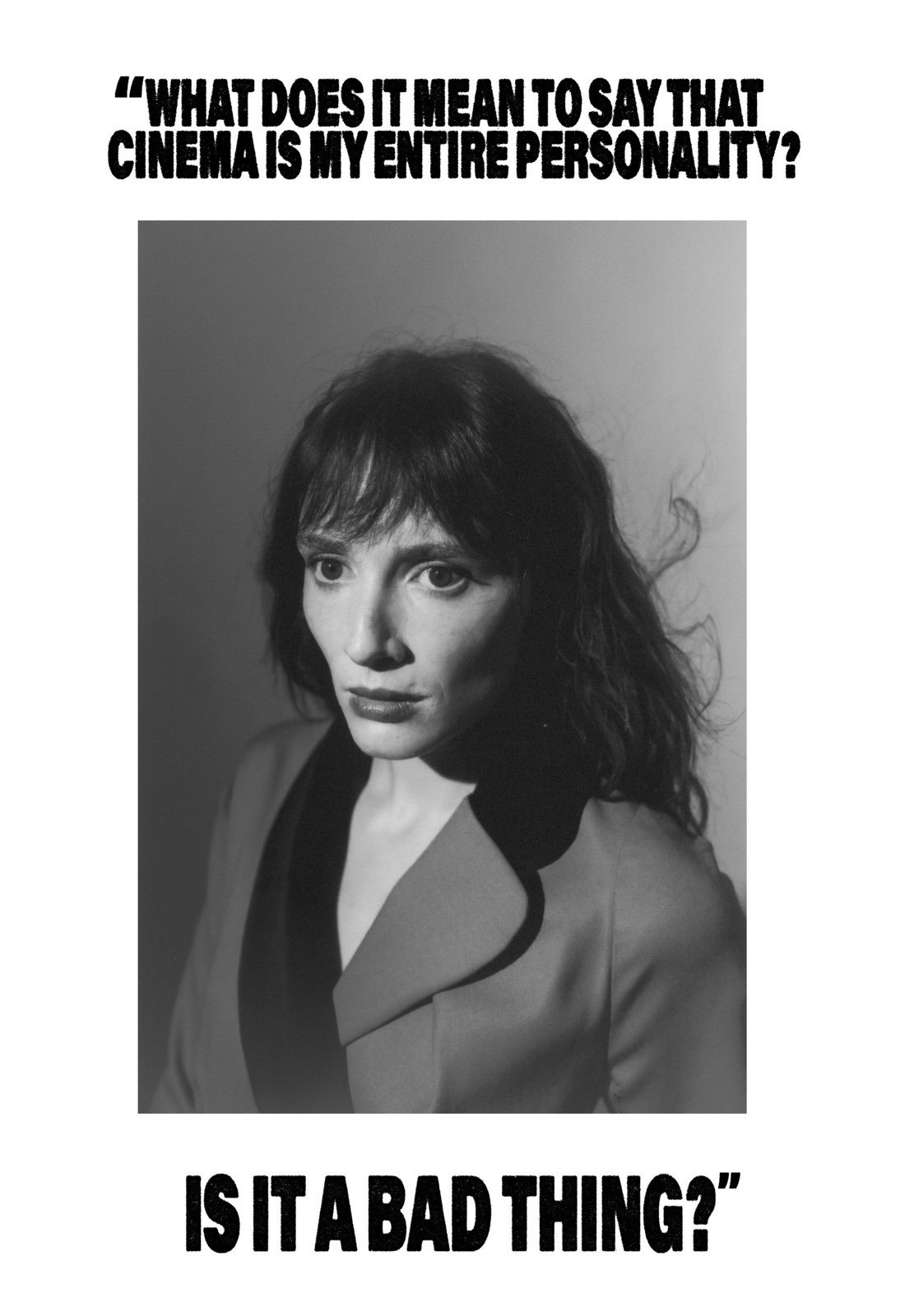
Blazer Vivienne Westwood
P: Through streaming releases, Red Rooms has been continuously discovered and embraced by new fans across the globe. How has that journey been for you?
JG: It’s crazy. It’s absolutely crazy. As a new actor, you can only hope to even work. Playing a lead wasn’t on my bingo card. And having the movie be loved? I really wasn’t expecting that. I was worried people wouldn’t get it. That they would think it’s too long, that nothing’s happening. Our attention span is so short nowadays. But I think people liked that it was weird and that we didn’t have all the answers. But going to festivals to present it, and then reading the Letterboxd reviews and just seeing how many there were... I thought, ‘I’m freaking out: this is my dream, and I’m living it.’ Just a rollercoaster of emotions.
P: You recently said, ‘I’m not interested in watching movies about men murdering women anymore.’ Why is that, and how was Red Rooms a different kind of story?
JG: I didn’t watch the Jeffrey Dahmer show, for example, because it stresses me out. I remember listening to so many true crime podcasts. Then Red Rooms came out, and a lot of eyeballs were on me. I was auditioning for bigger parts, and my nervous system kind of spiked. Since then, if I have free time, I’m not going to look at something upsetting like that. But I can watch Bring Her Back, I can watch Weapons...
P: Because they’re different. That’s not real life.
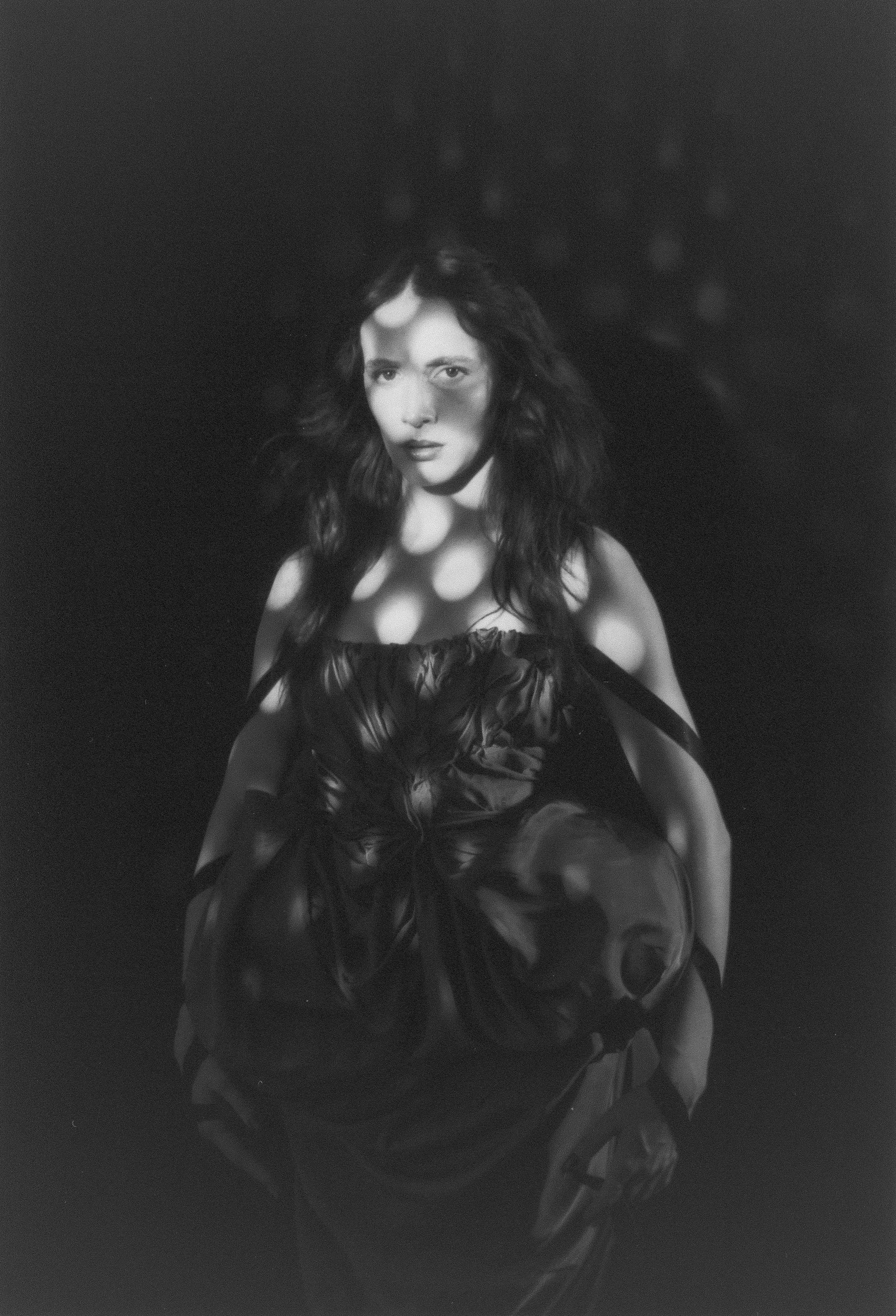
Dress Patrice Blais
JG: Exactly. We witness our sisters being murdered here constantly. We witness so much violence, with everything happening in the US and Palestine. I’m scared, and I think about it all the time, so when I do have a moment to myself, I’m not going to step into that. I’m always surprised when new projects are about the boyfriend killing the girlfriend. Aren’t we tired? But then, I think about the movie Pearl, and it’s a perfect re-writing. Pearl is bold because she’s the danger in the relationship. There is violence, there is murder, but it’s not gender-based.
P: I love that scene where David Corenswet is backing up because he’s so afraid of her. It completely subverts the whole dynamic.
JG: And he was trying to manipulate her before that. I’m not saying we should kill the man in the movie! But we are the ones getting killed by our boyfriends in real life, not the other way around. But yeah, Red Rooms is different, because she’s the vigilante. She’s a hero, but she has weird obsessions, and growing up in a world where we have full access to anything that has ever happened on the Internet, of course, we’re going to need more to be entertained.
It is hard to understand why she would be fascinated with such a gruesome killer, but then again, I feel like women’s anger and the violence against us is not recognised. Everyone focuses on the crazy guy who committed a crazy murder, and they call him a genius. They try to unlock his brain and understand what he did, but no girl, he just killed someone. Maybe that’s part of why she’s fascinated with violence.
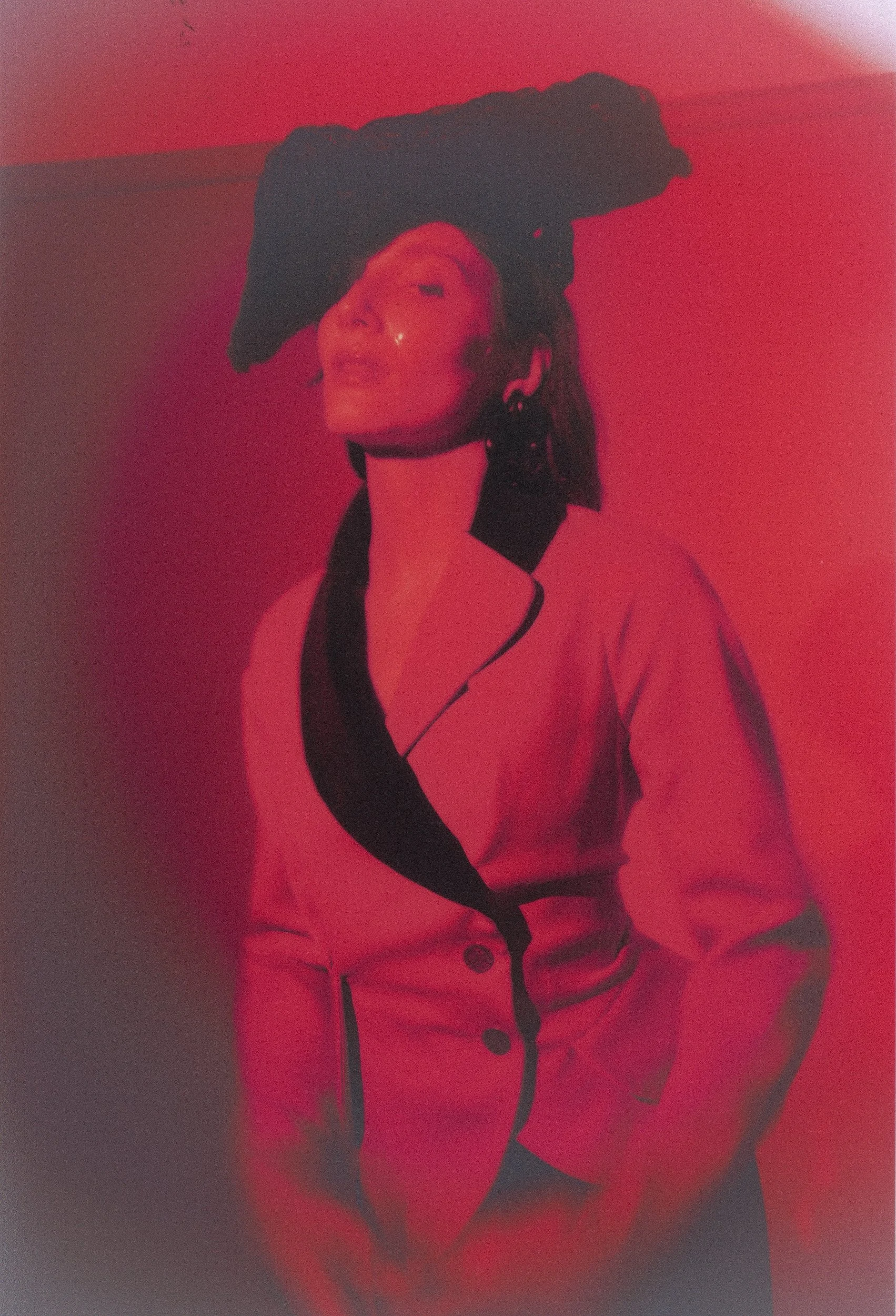
Blazer Vivienne Westwood Skirt Wardrobe.NYC
P: That’s very true. As a woman, you want to know what’s out there and what can happen to you. But at the same time, that can be unhealthy and disrespectful towards the victims. Red Rooms definitely changed my own relationship with true crime—did it change yours?
JG: You know Luka Magnotta? He killed and dismembered a student here in Montreal, and he sent a bunch of pieces to the government. And he filmed it and put it on the internet. I was in high school when it happened, and I remember people watching that video in class. And then Netflix did a series about it [Don’t F**k with Cats: Hunting an Internet Killer]. They filmed in the apartment where it happened, and it was just really gruesome and not even that interesting. But I realised that everyone was fascinated.
Now, I can’t listen to any more true crime podcasts. I used to fall asleep and wake up to them, but it became too much on my nervous system. You know those memes where people say something like, ‘I’ve listened to so much true crime that, wherever I go, I’m looking for the exit and where the killer might be hiding’? I don’t want to see the world that way. It’s already dark enough.
P: That’s a good outlook. What was your initial reaction to reading the screenplay?
JG: I was like, ‘Please let this movie be woke! Please don’t put the killer on a pedestal again!’ I really liked that we didn’t get all the answers, and that my character was kind of non-human. She could have been a spectral presence. Was she a witch or a ghost? Did she come for a specific mission and leave? She’s sociopathic, but that’s actually what allows her to do that work. In that story, we needed someone who wasn’t empathetic. She doesn’t have friends, she doesn’t have family—she’s kind of like Batman. He’s not here to please anyone; he’s just here to do the job, and that’s exactly what I fuck with. Kelly-Anne is also here to do the job, but the complexity is that, by doing the work, she might fulfil her little obsession. She’s getting off on her mission. It’s creepy, but she did some good in the end. When I read it, I remember thinking that I was a little bit like Kelly- Anne. To a certain extent, obviously, but I am looking at my phone the second I wake up and the second I go to bed. I am pushing my limit of entertainment constantly, and we’re all just consuming shit that rots our brains. It’s time to question our habits around what we consume. I really liked that commentary in Red Rooms.
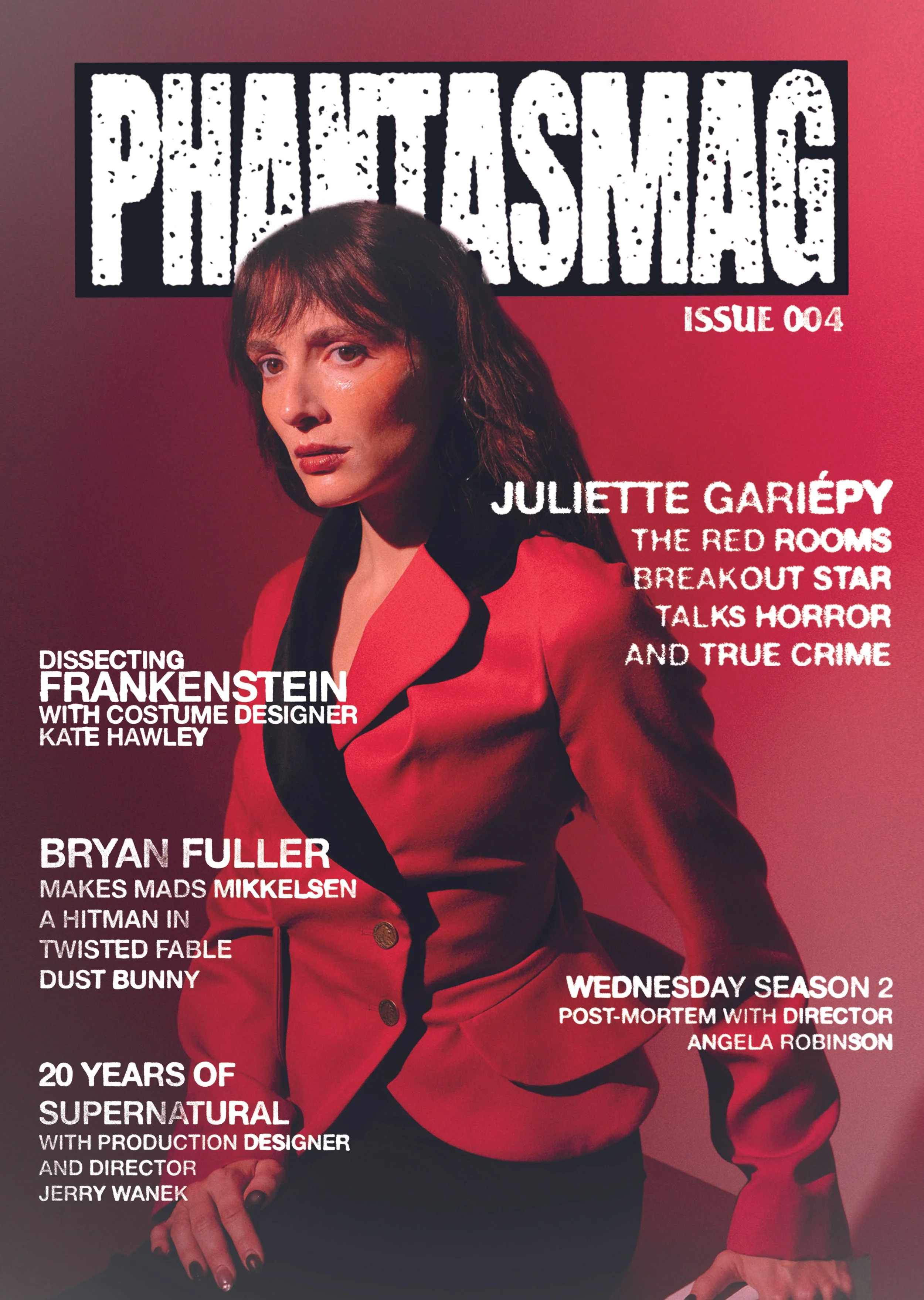
Product specifications: size B5, premium uncoated 120gsm heavy stock paper, 164 pages
All orders ship within a week
“I Can’t Listen to Any More True Crime Podcasts”: Juliette Gariépy on Red Rooms
The Quebecois actress reflects on her breakout role in Pascal Plante’s psychological thriller
by Lana Thorn 30 November 2025
Photography Lawrence Fafard Hair&make-up Miles Petrella Styling Patou Graphics Jack Rogers
Dress KNWLS Gloves La Collection
When I meet Juliette Gariépy over Zoom in September, I’m already strangely familiar with the image on the screen. Her dark web-obsessed, sociopathic protagonist in Red Rooms (Les Chambres rouges) spends much of the film staring intensely at a computer monitor. Fortunately, wearing a purple sweater and sipping on a Stanley cup, she’s bubbly, warm, and ever-so-slightly jittery ahead of her first-ever theatre performance later today (she’s starring as Herakles in an adaptation of Anne Carson’s Autobiography of Red at Montreal’s ESPACE GO). In summary, it’s not the face of a woman who’s seen a snuff film.
A hit on the 2023 festival circuit, Red Rooms is a disturbingly relevant, Fincher-esque horror thriller that dissects our attraction to violence and true crime in the digital age. It follows Kelly-Anne, a Montreal-based fashion model who becomes obsessed with the trial of Ludovic Chevalier, a man accused of killing and torturing three teenage girls. What’s more, the crimes were live-streamed for a paying audience in online spaces known as “red rooms”. Unlike her friend Clementine (Laurie Babin), Kelly-Anne is no mindless serial killer groupie, and Gariépy keeps us guessing as to what really fuels her interest in the case with a sensational performance that earned her the Prix Iris for Revelation of the Year at the Quebec Cinema Awards.
Over the past year, thanks to excellent word of mouth and streaming releases on Shudder in the US and BFI Player in the UK, the film has continued to excite and horrify viewers around the world. It has also kick-started Gariépy’s career, who next stars in the romantic comedy Mile End Kicks and Jaume Collet-Serra’s survival thriller Play Dead. Looking back on her first major role, Gariépy calls me from her flat in Montreal to discuss the culture of true crime fanatics, the complexities of playing an anti-hero, and why she’s tired of films about the murder of women.
Dress Patrice Blais
Phantasmag: In many ways, Red Rooms is about our attraction to horrific images. Do you remember the first horror film that terrified you?
Juliette Gariépy: Orphan. I remember being freaked out with my friends and absolutely loving it. We started watching more, and it was always this cool adventure to go to the video rental store, choose a movie, and come back home to get really scared. Orphan opened the door to that world for me, and I really enjoyed having a crazy female lead onscreen.
P: It’s such a modern classic. When did you realise you wanted to be an actor?
JG: There was this series of books about a young girl in Quebec called Aurélie Laflamme, and I found out they were doing a movie. I was obsessed—both with the story and with the idea of bringing it to life. I asked my mom if I could audition, and she was like, ‘No, you’re a kid.’ I was really mad, but later I went on my own to try out for some commercial because my friend’s grandma was a casting director. Eventually, my mom gave in, and I auditioned for the Aurélie Laflamme film. I didn’t get it, but the experience sparked something in me.
Full look Le Grand Costumier
P: Your dress for TIFF premiere of Mile End Kicks was decorated with the words, ‘My body is a machine that turns my film career into my whole personality.’ What does that phrase mean to you
JG: I wanted to do something bold, where people would have to stop, look, and read. TIFF is huge, and I wanted to be seen, to do a little stunt for myself. I thought, ‘What does it mean to say that cinema is my entire personality?’ Is it a bad thing? Because it’s true, I think about it all the time. And you have to sell yourself. My Instagram isn’t completely personal because some producer who saw Red Rooms will look me up online. Actors have to be interesting and mysterious. It’s not healthy all the time, but I do feel like it’s becoming my whole personality. It’s complicated, but that desire to be wanted and chosen—it lives in me all the time.
Also, I think everyone in this industry has to be a little obsessed with cinema. But then again, that will probably change because now we’re consuming other media, and it’s harder to get people into theatres. Everyone saw Weapons, but still.
P: What did you think of Weapons?
JG: I loved it. But you know what I liked even more? Bring Her Back. That was fucking triggering. It was a beautiful depiction of grief. And Weapons was more of a fun ride.
Blazer Vivienne Westwood
P: Through streaming releases, Red Rooms has been continuously discovered and embraced by new fans across the globe. How has that journey been for you?
JG: It’s crazy. It’s absolutely crazy. As a new actor, you can only hope to even work. Playing a lead wasn’t on my bingo card. And having the movie be loved? I really wasn’t expecting that. I was worried people wouldn’t get it. That they would think it’s too long, that nothing’s happening. Our attention span is so short nowadays. But I think people liked that it was weird and that we didn’t have all the answers. But going to festivals to present it, and then reading the Letterboxd reviews and just seeing how many there were... I thought, ‘I’m freaking out: this is my dream, and I’m living it.’ Just a rollercoaster of emotions.
P: You recently said, ‘I’m not interested in watching movies about men murdering women anymore.’ Why is that, and how was Red Rooms a different kind of story?
JG: I didn’t watch the Jeffrey Dahmer show, for example, because it stresses me out. I remember listening to so many true crime podcasts. Then Red Rooms came out, and a lot of eyeballs were on me. I was auditioning for bigger parts, and my nervous system kind of spiked. Since then, if I have free time, I’m not going to look at something upsetting like that. But I can watch Bring Her Back, I can watch Weapons...
P: Because they’re different. That’s not real life.
Dress Patrice Blais
JG: Exactly. We witness our sisters being murdered here constantly. We witness so much violence, with everything happening in the US and Palestine. I’m scared, and I think about it all the time, so when I do have a moment to myself, I’m not going to step into that. I’m always surprised when new projects are about the boyfriend killing the girlfriend. Aren’t we tired? But then, I think about the movie Pearl, and it’s a perfect re-writing. Pearl is bold because she’s the danger in the relationship. There is violence, there is murder, but it’s not gender-based.
P: I love that scene where David Corenswet is backing up because he’s so afraid of her. It completely subverts the whole dynamic.
JG: And he was trying to manipulate her before that. I’m not saying we should kill the man in the movie! But we are the ones getting killed by our boyfriends in real life, not the other way around. But yeah, Red Rooms is different, because she’s the vigilante. She’s a hero, but she has weird obsessions, and growing up in a world where we have full access to anything that has ever happened on the Internet, of course, we’re going to need more to be entertained.
It is hard to understand why she would be fascinated with such a gruesome killer, but then again, I feel like women’s anger and the violence against us is not recognised. Everyone focuses on the crazy guy who committed a crazy murder, and they call him a genius. They try to unlock his brain and understand what he did, but no girl, he just killed someone. Maybe that’s part of why she’s fascinated with violence.
Blazer Vivienne Westwood Skirt Wardrobe.NYC
P: That’s very true. As a woman, you want to know what’s out there and what can happen to you. But at the same time, that can be unhealthy and disrespectful towards the victims. Red Rooms definitely changed my own relationship with true crime—did it change yours?
JG: You know Luka Magnotta? He killed and dismembered a student here in Montreal, and he sent a bunch of pieces to the government. And he filmed it and put it on the internet. I was in high school when it happened, and I remember people watching that video in class. And then Netflix did a series about it [Don’t F**k with Cats: Hunting an Internet Killer]. They filmed in the apartment where it happened, and it was just really gruesome and not even that interesting. But I realised that everyone was fascinated.
Now, I can’t listen to any more true crime podcasts. I used to fall asleep and wake up to them, but it became too much on my nervous system. You know those memes where people say something like, ‘I’ve listened to so much true crime that, wherever I go, I’m looking for the exit and where the killer might be hiding’? I don’t want to see the world that way. It’s already dark enough.
P: That’s a good outlook. What was your initial reaction to reading the screenplay?
JG: I was like, ‘Please let this movie be woke! Please don’t put the killer on a pedestal again!’ I really liked that we didn’t get all the answers, and that my character was kind of non-human. She could have been a spectral presence. Was she a witch or a ghost? Did she come for a specific mission and leave? She’s sociopathic, but that’s actually what allows her to do that work. In that story, we needed someone who wasn’t empathetic. She doesn’t have friends, she doesn’t have family—she’s kind of like Batman. He’s not here to please anyone; he’s just here to do the job, and that’s exactly what I fuck with. Kelly-Anne is also here to do the job, but the complexity is that, by doing the work, she might fulfil her little obsession. She’s getting off on her mission. It’s creepy, but she did some good in the end. When I read it, I remember thinking that I was a little bit like Kelly- Anne. To a certain extent, obviously, but I am looking at my phone the second I wake up and the second I go to bed. I am pushing my limit of entertainment constantly, and we’re all just consuming shit that rots our brains. It’s time to question our habits around what we consume. I really liked that commentary in Red Rooms.
Product specifications: size B5, premium uncoated 120gsm heavy stock paper, 164 pages
All orders ship within a week